

What if the biggest threat to your sobriety isn't the world outside, but the lack of a safe place to land after treatment? For many, the transition from a clinical environment back to the familiar streets of Central Massachusetts feels like walking a tightrope without a net. You want to stay clean, but the fear of ending up in an unsafe "flop house" or returning to old triggers makes the future feel overwhelming. Finding a reputable sober house Worcester Massachusetts families can trust is often the most critical part of the journey. You deserve more than just a bed. You need a space that balances your new independence with the firm accountability required to truly rebuild.
We understand that this transition is about more than just staying dry; it's about reclaiming your dignity and your future. This guide will show you how a MASH-certified sober house in Worcester provides the essential bridge between clinical care and a life of lasting independence. We'll explore the rigorous standards that keep these homes safe, how peer communities foster genuine healing, and how structured living helps you reconnect with work and family. You'll discover how to find a community that offers the stability you need to move forward with confidence and peace of mind.
Key Takeaways
- Learn why structured sober living serves as the critical third phase of recovery, helping you manage urban triggers after clinical treatment ends.
- Understand why MASH certification is the gold standard for a sober house Worcester Massachusetts families trust for safety and oversight.
- Discover the differences between independent recovery housing and state-funded halfway houses to find the right balance of autonomy and support.
- Explore how daily routines and peer fellowship provide the steady foundation you need to successfully reconnect with your work and family.
- Find out how a philosophy focused on being willing and determined empowers you to transition from intensive care to a life of lasting independence.
Navigating the Transition: Why a Sober House in Worcester is Your Next Step
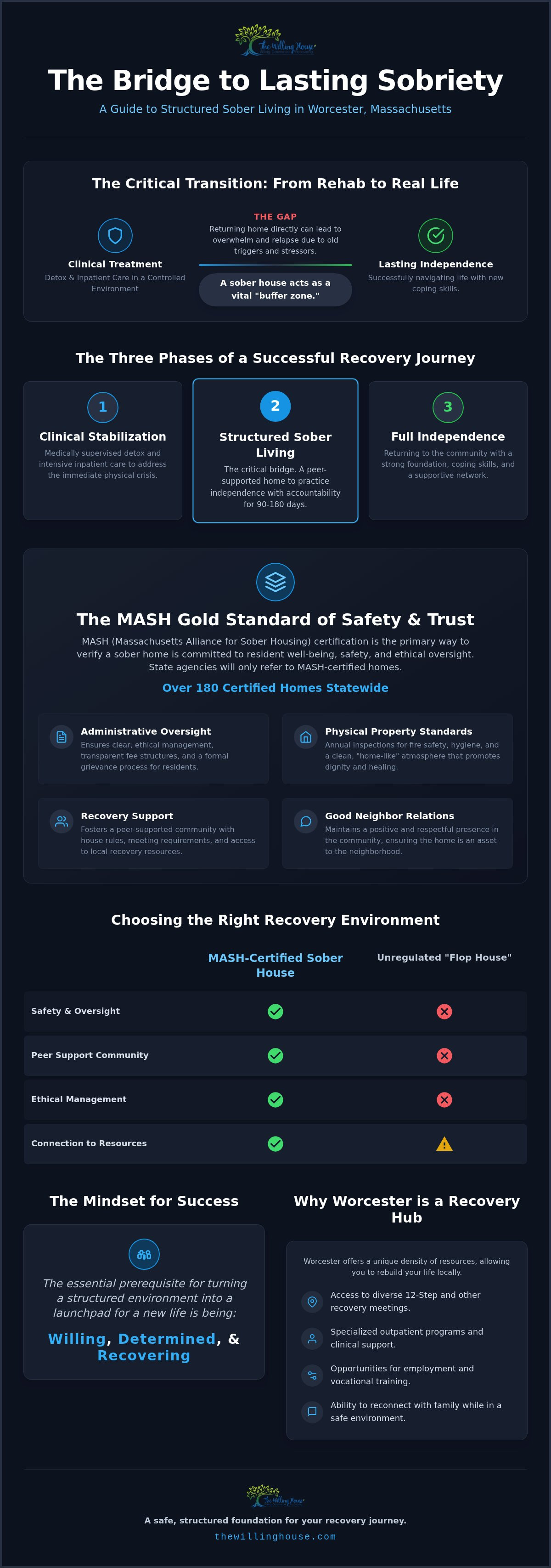
The transition from clinical treatment to everyday life is often the most vulnerable period in a person's recovery. You've completed detox and intensive inpatient care, but the thought of returning directly to your old environment feels risky. This is where sober living houses serve as the critical "third phase" of the journey. Unlike clinical rehab centers that focus on medical stabilization, these homes prioritize independent living within a structured, peer-supported environment. It's about learning how to live again, one day at a time, while surrounded by people who share your goals and understand your struggle.
Choosing a sober house Worcester Massachusetts families trust means acknowledging the unique challenges of our local urban landscape. Worcester is a city of growth and opportunity, but it also contains the familiar triggers and social circles that may have fueled past struggles. To navigate this successfully, a resident must embrace a specific internal posture. Being "Willing, Determined, and Recovering" is the essential prerequisite for success, as it turns a structured living environment from a simple set of rules into a powerful launchpad for a new life.
The Gap Between Rehab and Home
Going straight home after treatment often leads to a quick return to old patterns. Your brain is still healing, and the stressors of bills, family dynamics, and old neighborhood associations can be overwhelming without a safety net. A sober house acts as a vital "buffer zone," typically recommended for the first 90 to 180 days of sobriety. This period allows you to practice new coping skills in a controlled setting. You stay connected to your Worcester support network, but you have a physical barrier between yourself and the risks of your old life.
Choosing Worcester for Your Recovery Journey
Worcester is uniquely positioned as a recovery hub in Central Massachusetts. The city offers an incredible density of resources, from diverse 12-step meetings to specialized outpatient programs and vocational training. Staying local means you don't have to put your life on hold in a distant town where you have no roots. You can find employment, attend school, or begin the delicate process of family reconnection right here. The benefit is clear: you build your new life in the same city where you intend to live it, all while having a safe, clean, and accountable home to return to at the end of the day.
Understanding MASH Certification: The Gold Standard for Worcester Sober Living
MASH stands for the Massachusetts Alliance for Sober Housing. This organization manages the voluntary certification of Massachusetts sober homes, ensuring they meet national standards for safety, ethics, and recovery support. For anyone searching for a sober house Worcester Massachusetts families can rely on, this certification is the primary way to verify that a home is more than just a rental property. It signifies a commitment to recovery-oriented housing that prioritizes the resident's well-being over profit. Certification isn't a one-time event; it requires a rigorous annual renewal process and regular inspections to ensure standards never slip.
Clinical providers and the Massachusetts court system prioritize these homes because they offer a level of oversight that unregulated "flop houses" simply don't have. In fact, state agencies and their vendors will only refer individuals to houses that have earned this badge of quality. This creates a safer environment for everyone involved, from the residents themselves to the broader Worcester community. With over 180 MASH-certified homes operating across the state as of 2026, the network of professional recovery housing is stronger than ever.
The Core Pillars of a MASH-Certified Home
A certified home must excel in four main areas: administrative oversight, physical property standards, recovery support, and good neighborly relations. This means the house must have clear, ethical management and a transparent grievance process for residents. The physical space is inspected for fire safety, proper hygiene, and a "home-like" atmosphere that feels welcoming rather than institutional. These standards ensure that every resident has a clean, safe, and dignified place to focus on their growth without the distractions of a poorly managed facility.
Why Certification Protects Your Investment in Sobriety
Choosing an unregulated house in Central MA is a gamble that often leads to disappointment or relapse. Without MASH oversight, there's no guarantee of accountability for house managers or owners. Certification protects your investment of time and effort by ensuring the home follows the latest state guidelines, including compliance with recent judicial rulings regarding local licensing. Families can rest easier knowing their loved one is in a vetted environment where rules are enforced fairly and consistently. If you're looking for a foundation built on these high standards, you can explore the MASH-certified community at The Willing House to see how professional oversight supports personal growth.
Evaluating Recovery Environments: What Sets the Best Worcester Sober Houses Apart?
When you start looking for a sober house Worcester Massachusetts has to offer, you'll likely notice two distinct paths: state-funded halfway houses and independent sober living communities. Halfway houses are often transitional programs tied to the Department of Public Health, providing clinical oversight and a more institutional feel. In contrast, independent sober living is a private, peer-based model that emphasizes personal responsibility. This distinction is vital because research on the effectiveness of sober living suggests that the peer-support environment is a key driver in preventing relapse and building long-term stability. A healthy house culture thrives on a peer-led model where residents hold each other up, rather than a staff-forced environment that can feel punitive or clinical.
The best environments strike a delicate balance between freedom and structure. While you're encouraged to return to work or reconnect with family, you're also held to high standards through regular testing and curfews. This structure isn't meant to be restrictive; it's designed to provide the safety you need to practice your recovery in the real world. By choosing a community that values both autonomy and accountability, you're setting yourself up for a transition that lasts well beyond your first few months of sobriety.
Men’s vs. Women’s Sober Living in Worcester
Recovery needs aren't one-size-fits-all, and gender-specific housing often provides a more focused environment for healing. Men in recovery frequently benefit from a culture of "brotherhood" that breaks down isolation and builds healthy, honest communication. For women, the focus is often on creating a space defined by emotional safety and clear physical boundaries. The Willing House recognizes these distinct journeys, offering specialized environments for both men and women that address their unique peer support needs while maintaining the same high standards of accountability.
Questions to Ask Before You Sign a Resident Agreement
Before committing to a home, it's essential to understand the daily expectations. You should ask about the specific policy on random drug screening and daily breathalyzers; consistency in these areas is what keeps the home safe for everyone. Inquire about how conflict is resolved within the peer community to ensure there's a healthy, respectful process in place. Finally, clarify the expectations for employment or outpatient treatment. A reputable house will have clear rules that help you stay productive while ensuring your recovery remains the top priority.
Building a Life in Central MA: The Structure and Community of Independent Living
Life in a sober house Worcester Massachusetts residents call home is defined by a steady, predictable rhythm. This structure isn't about control; it's about creating the space for new, healthy habits to take root. Most days begin with a morning check-in or personal reflection before residents head out to work, school, or outpatient treatment. In the evenings, the focus shifts back to the house community through mandatory house meetings and shared meals. These gatherings aren't just for logistics. They're where peer fellowship happens, allowing you to share successes and troubleshoot challenges with people who truly understand the journey.
Discipline is the backbone of lasting recovery. Simple acts like maintaining a clean room, completing assigned chores, and adhering to curfews might seem minor, but they build the mental muscle needed for long-term success. This discipline helps you transition from the high-supervision environment of rehab to the self-directed life of an independent adult. By integrating with Worcester's vibrant local AA/NA scene, residents find a wider network of support that extends far beyond the walls of their home. This connection to the local recovery community ensures that you're never walking this path alone.
The Role of Accountability Protocols
Safety in a recovery environment is a shared responsibility. Daily breathalyzers and random drug screenings are essential tools that protect the "collective sobriety" of the house. They aren't punishments. Instead, they provide a sense of security for every resident, knowing that their home remains a drug-free sanctuary. When everyone is held to the same high standard, it fosters a deep level of trust and mutual respect among peers. These protocols ensure that the environment stays focused on growth rather than the chaos of active addiction.
Reconnecting with the Worcester Community
Rebuilding your life means stepping back into the world with a plan. Worcester offers a wealth of employment opportunities for those in early recovery, and being in a structured home provides the stability needed to keep a job. Many residents also choose to attend local clinical programs like Lake Avenue Recovery to continue their healing while living in a supportive environment. As you demonstrate consistent, supervised progress, you begin to mend the bridges with your family and loved ones. This journey of reconnection is supported by the structured living program at The Willing House, which empowers you to lead a productive life while maintaining your sobriety.
The Willing House: A Safe, Structured Foundation for Your Recovery Journey
The Willing House stands as a premier sober house Worcester Massachusetts residents rely on for quality and integrity. As a MASH-certified community, we embody the rigorous safety and management standards discussed throughout this guide. Our independent living model is designed to empower you, providing a stable environment where you can practice the skills learned in clinical care. We believe that recovery isn't just about the absence of substances; it's about the presence of a meaningful, self-directed life. By choosing a home that values your dignity and personal growth, you're giving yourself the best possible chance at a lasting transformation that extends far beyond your first 90 days.
We provide more than just a place to sleep. Our commitment to a safe, supportive, and structured peer community means that you'll always have a foundation to lean on when things get tough. We don't just offer housing; we offer a path toward independence that balances personal freedom with the firm accountability required for success. It's about building a life you're proud of, starting right here in the heart of Central Massachusetts. When you join our community, you aren't just a resident; you're a vital part of a group dedicated to mutual aid and shared success.
Our Philosophy: Willing, Determined, Recovering
At the heart of our community is a simple yet profound philosophy: "Willing, Determined, Recovering." This isn't just a slogan; it's the standard we live by every day. Being part of The Willing House means surrounding yourself with peers who share your commitment to growth. We focus on dignity, respect, and mutual support, creating an atmosphere where you're never just a number. Many Worcester residents who have walked through our doors have found success here because we treat them as capable adults ready to reclaim their lives. This shared culture of accountability ensures that every person in the house is moving toward the same goal: a future defined by health and purpose.
Taking the Next Step: The Application Process
Starting your transition shouldn't be a source of anxiety. Our application process is designed to ensure that every new resident is a good fit for our culture of accountability. When you apply for a bed, you'll participate in an initial interview and intake process. This is a chance for us to learn about your journey and for you to see if our structured living environment matches your needs. We look for individuals who are ready to embrace independence while following the protocols that keep our community safe. If you're ready to move forward, we're here to provide the foundation you need. Start your journey today—Apply to The Willing House and take the first step toward a life of lasting independence.
Your New Chapter Starts with a Solid Foundation
Rebuilding a life after clinical treatment requires more than just a place to stay; it requires a community that understands the weight of the journey. We've explored how MASH certification serves as a vital mark of quality and how a structured environment provides the necessary buffer against old triggers. Choosing a sober house Worcester Massachusetts families can trust means prioritizing a space where personal growth is supported by peer-driven accountability and professional oversight. This is about more than just surviving. It's about thriving in a home that values your dignity and your future.
The transition to independent living is a bold step toward the life you deserve. If you're ready to move forward, the right environment makes all the difference. Our safe and structured homes are designed to help you reconnect with your work, your family, and your sense of purpose. Join a supportive recovery community in Worcester—Apply to The Willing House today. You've already done the hard work of starting your recovery. Now, let us provide the stable foundation you need to keep moving forward with confidence and peace of mind.
Frequently Asked Questions
What is the difference between a sober house and a halfway house in Massachusetts?
The primary difference lies in the level of clinical oversight and funding. Halfway houses are often state-funded through the Department of Public Health and include on-site clinical staff or mandatory treatment programs. Sober houses are peer-led, independent living environments where residents manage their own recovery while following house rules. This model focuses on real-world integration, allowing you to work and attend outside meetings while maintaining personal accountability within a supportive community.
How much does a sober house in Worcester, MA cost per week?
Weekly rates for a sober house Worcester Massachusetts residents choose can vary based on the specific amenities provided. As of early 2026, some local homes offer all-inclusive rates around $190 per week, which covers housing, utilities, and regular drug screenings. Most houses also require a move-in deposit. It's important to verify current rates directly with individual house managers, as pricing can change based on the level of structure and support offered.
Does insurance cover sober living in Worcester?
Standard health insurance policies generally don't cover the cost of sober living because it's classified as recovery housing rather than medical treatment. While insurance pays for detox or residential rehab, sober living is usually a self-pay expense. Some residents in Massachusetts may qualify for assistance through the HUD-funded Recovery Housing Program, which can provide rental vouchers of up to $3,000 for those meeting specific state eligibility requirements as of 2026.
Can I work a full-time job while living at The Willing House?
Yes, working a full-time job is a core component of the independent living model at The Willing House. We believe that steady employment helps build the discipline and financial stability necessary for long-term success. Once you've completed your initial intake and settled into the house routine, you're encouraged to pursue work or education. Our structure is designed to support your professional goals while ensuring you remain grounded in your recovery.
What happens if someone relapses in the sober house?
To protect the safety and sobriety of the entire community, anyone who relapses is usually asked to leave the house immediately. This firm boundary is necessary to maintain a drug-free environment for the other residents. We don't view this as a punishment, but as a step to ensure the individual gets the higher level of care they need. We often help facilitate transitions back into clinical treatment or detox programs when a relapse occurs.
Are visitors allowed at The Willing House?
Visitors are allowed during designated hours as long as they are sober and follow all house protocols. We understand that reconnecting with family and healthy friends is a vital part of the healing process. However, all guests must be pre-approved by house management to ensure the environment remains peaceful and safe. Any visitor who appears to be under the influence or brings triggers into the home will be asked to leave.
Is MASH certification required for a sober house to operate in Worcester?
MASH certification is voluntary but serves as the essential mark of safety for any sober house Worcester Massachusetts families consider. While a home can technically operate without it, state agencies and clinical providers will only refer people to certified locations. Additionally, a 2025 Massachusetts Supreme Judicial Court ruling (SJC-13639) has given cities more power to regulate homes through local zoning, making the oversight provided by MASH certification even more important for stability.
How long do residents typically stay in a Worcester sober house?
Residents typically stay between three to six months, though the timeline is flexible based on individual needs. Some people find that 90 days provides the necessary buffer zone to stabilize their recovery, while others benefit from a year of structured living. The goal is always a successful transition to independent housing. You and the house community will work together to determine when you're truly ready to manage your sobriety without daily oversight.
