

Imagine standing at the doors of a treatment center with your bags packed, feeling stronger than ever, yet terrified because your bank account is empty. You know that returning to your old neighborhood puts your hard-earned progress at risk, but the cost of a safe, structured environment feels completely out of reach. It's an overwhelming feeling, but you aren't alone in this struggle. Finding sober living financial assistance Massachusetts is often the missing piece of the puzzle that turns a fragile transition into a stable, long-term success story.
We understand that the application process for state aid can feel like a maze when you're already managing the weight of early recovery. That's why this 2026 guide is designed to simplify your path. You'll discover how to access the Recovery Housing Program (RHP) vouchers, which can provide up to $3,000 in support, and learn about private scholarships like Power Forward. We will also explain why MASH-certified homes, such as The Willing House in Worcester, are essential for qualifying for these specific funds. By the end of this article, you'll have a clear roadmap to secure the financial support you need for a safe, supportive home.
Key Takeaways
- Learn how to access sober living financial assistance Massachusetts through the Recovery Housing Program (RHP), which can provide up to $3,000 for qualifying residents.
- Explore private scholarship opportunities from organizations like the Herren Project and Power Forward to bridge the financial gap during your first few weeks of residency.
- Understand why choosing a MASH-certified home is a prerequisite for most state-funded aid, ensuring you receive both financial help and high safety standards.
- Follow a clear, step-by-step application process that begins with securing a clinical referral from your current treatment provider or case manager.
- Discover local recovery resources in Worcester, including how MASH-certified communities like The Willing House support residents in navigating these funding hurdles.
Understanding Sober Living Costs and the Need for Assistance
Early recovery is a period of massive change. You're trying to find a job, attend outpatient meetings, and rebuild relationships, all while staying focused on your health. The financial reality of this transition can feel heavy. While clinical treatment centers focus on medical stabilization, What is a sober living house? It is a bridge to independence where you pay for a safe environment and peer support rather than medical care. Finding sober living financial assistance Massachusetts is often the only way to ensure this bridge doesn't collapse under the weight of everyday bills.
Choosing a house based solely on the lowest price can be a dangerous mistake. Uncertified "discount" homes often lack the oversight and safety standards required to protect your sobriety. In contrast, MASH-certified residences like The Willing House follow strict guidelines for accountability and community wellness. Investing in a certified home means you're investing in a proven structure; fortunately, this certification is exactly what makes you eligible for many state-funded grants and vouchers.
Weekly Fees vs. Clinical Treatment Costs
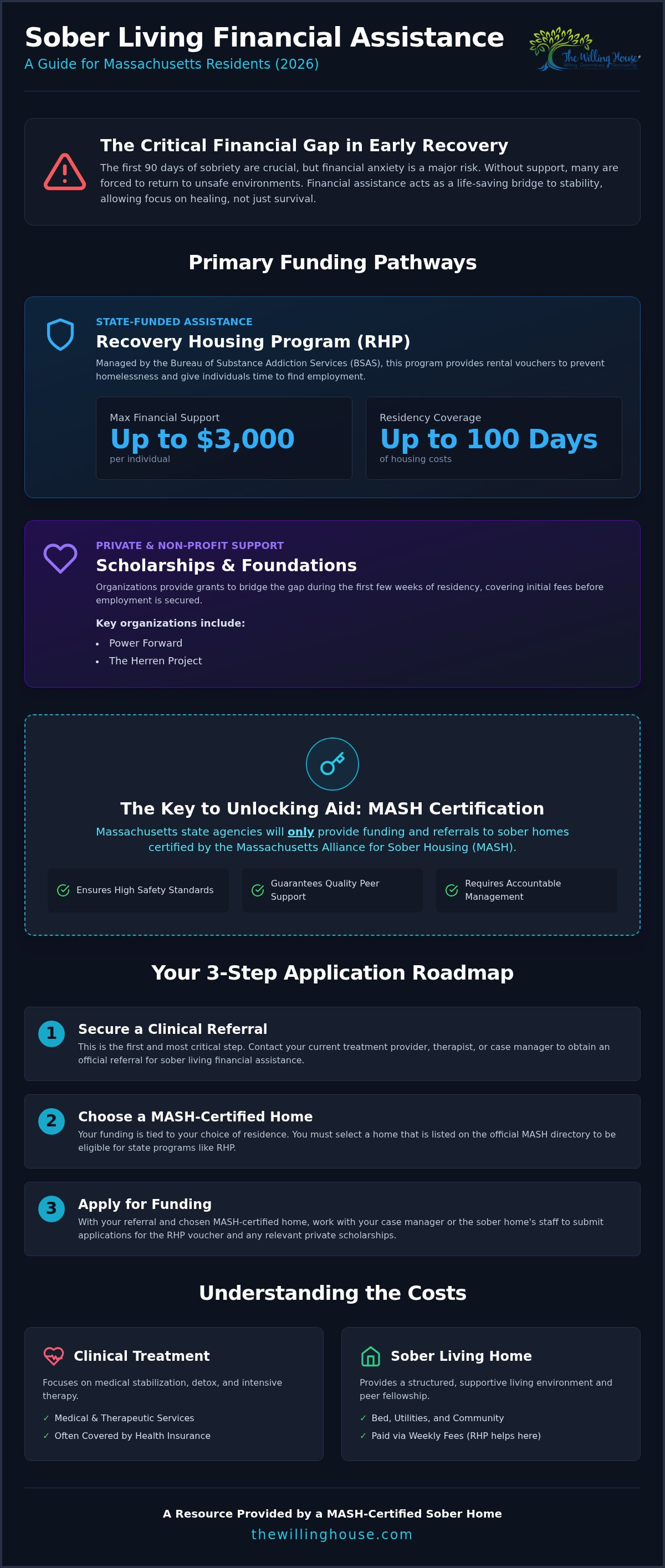
Clear communication about where your money goes is vital for your peace of mind. Insurance companies usually cover detoxification and inpatient programs because they are medical services. Sober living houses are different. They provide a structured living environment and peer fellowship. Your weekly residency fee covers your bed, utilities, and access to a community of like-minded individuals. It doesn't include clinical therapy or medical detox. Knowing this distinction helps you plan your budget and identify which specific costs require external funding or scholarships.
The Financial Barrier to Quality Recovery
The first 90 days of sobriety are often the most stressful. Financial anxiety is a common trigger for cravings, and many people feel pressured to return to high-stress, unsafe environments just to save money. This is where sober living financial assistance Massachusetts becomes a life-saving resource. Seeking out grants or vouchers isn't an admission of failure. It is a proactive, responsible step toward a successful recovery. By removing the immediate fear of debt, you give your mind the space it needs to focus entirely on healing and long-term stability.
State-Funded Financial Assistance: The Recovery Housing Program (RHP)
The Bureau of Substance Addiction Services (BSAS) manages the State-Funded Recovery Housing Program (RHP), which serves as a vital lifeline for people in early recovery. For 2026, this program continues to be a primary source of sober living financial assistance Massachusetts residents use to secure a safe place to live. The state recognizes that the gap between leaving a treatment facility and finding a stable job is often when people are most vulnerable. By providing targeted rental vouchers, the RHP aims to prevent homelessness and provide the stability needed for long-term success.
The state manages these funds with a focus on accountability and results. Vouchers typically provide up to $3,000 per individual, covering a residency period of up to 100 days. This financial cushion is designed to give you enough time to find employment and begin contributing to your own housing costs without the constant threat of being back on the street. In recent budget cycles, the state has continued to prioritize these funds, ensuring that the path from clinical care to independent living remains open for those with limited income.
The Role of MASH in Funding
There is a direct link between accountability and assistance. Massachusetts state agencies and their vendors only refer individuals to houses certified by the Massachusetts Alliance for Sober Housing (MASH). This requirement exists because certification ensures the home meets specific standards for safety, peer support, and management. By only funding MASH-certified homes, the state protects its investment and, more importantly, protects your well-being. Before you apply for any state-funded aid, you must verify that your chosen house is on the official MASH directory. If you're searching for a community that upholds these rigorous standards, you may want to contact a MASH-certified sober home in Worcester to see if they have current openings for voucher recipients.
Types of State Aid Available
The aid available in 2026 is categorized to meet different stages of the recovery journey. Understanding which one fits your situation can speed up the application process:
- RHP Rental Vouchers: These are specifically for individuals in certified sober homes who have limited or no current income.
- Residential Assistance Program (RAP): This program also offers up to $3,000 or 100 days of assistance for residents in MASH-certified housing.
- Transitional Housing Grants: Often used for individuals moving directly from inpatient care, these grants help cover the initial security deposit and the first few weeks of residency.
To qualify for these programs, you generally need to provide proof of financial need and have a clinical referral from a treatment provider. The process is methodical and thorough, ensuring that the sober living financial assistance Massachusetts provides is directed toward individuals who are committed to a structured, substance-free lifestyle.
Non-Profit Scholarships and Private Foundations in Massachusetts
While state vouchers provide a strong foundation, they aren't the only way to fund your stay in a recovery residence. Private foundations and non-profit organizations play a massive role in offering sober living financial assistance Massachusetts families rely on during the critical first weeks of sobriety. These organizations are often founded by people who have walked this path themselves. This background means their approach is deeply personal and empathetic, focusing on the dignity of the individual rather than just the paperwork.
One of the most prominent resources is the Herren Project. They offer housing scholarships that cover the initial costs of moving into a certified sober home. Similarly, state-level initiatives like the Center for Community Recovery Innovations (CCRI) grants have awarded over $17.5 million to help create and preserve affordable sober housing throughout the Commonwealth. These funds ensure that high-quality, safe environments remain accessible even when personal funds are low, helping to bridge the gap between treatment and long-term stability.
Top Recovery Foundations to Explore
Several local foundations focus specifically on the Massachusetts recovery community. The Pelican Intervention Fund, for example, provides funding for residents moving into MASH-certified homes, focusing on those coming from the North Shore. Think of Michael is another vital resource that prioritizes the transition from clinical care to independent living. For families who are struggling to support a loved one's recovery, The Family Restored offers grants to help cover the costs of a structured sober house. Another valuable resource is the Power Forward scholarship, which typically covers three to six weeks of residency fees for individuals who show a strong commitment to their recovery plan.
Applying for Private Scholarships
Securing a private scholarship requires more than just financial need; it requires a demonstration of accountability. Committees look for individuals who are actively participating in their own journey. You'll usually need a referral from a clinical provider or a case manager at your treatment facility to prove you're ready for this level of independence.
When writing your personal statement, be honest about your goals and your commitment to the house rules. Most foundations prioritize applicants who attend 12-step meetings or engage heavily in peer support. They want to see that their investment is going toward someone who values the structure of a MASH-certified environment. If you're currently in Worcester, applying these scholarships toward a stay at The Willing House can provide the stable, supportive foundation you need to rebuild your life without the immediate pressure of residency fees.
How to Apply: A Step-by-Step Guide for Worcester Residents
Applying for sober living financial assistance Massachusetts residents need shouldn't feel like a full-time job. While the paperwork can seem daunting, the process is actually a series of manageable steps designed to ensure you're entering a safe, accountable environment. By following a structured path, you can move from a clinical setting into a supportive home without the weight of immediate financial stress. If you're currently in Worcester or Central Massachusetts, here is how you can secure the funding you need to protect your recovery.
- Step 1: Obtain a Clinical Referral. Most funding sources, including the RHP, require a referral from your current treatment provider. This confirms that you've completed a higher level of care and are ready for the independence of a sober house.
- Step 2: Identify MASH-Certified Houses. You must choose a home that meets state standards. In Worcester, The Willing House is a recognized MASH-certified option that provides the structure required by state voucher programs.
- Step 3: Contact the House Manager. Reach out to the house directly to verify bed availability. It's also the time to ask if they have current experience processing RHP vouchers or private scholarships like the Herren Project.
- Step 4: Complete the Paperwork. Once a house confirms they can take you, you'll need to fill out the specific RHP or foundation application. Your case manager can often help you with the technical details.
- Step 5: Follow Up. Don't let your application sit. Stay in regular contact with the MASH office or your scholarship committee to ensure they have everything they need to approve your funding.
Local Resources in Worcester and Central MA
Staying local in Worcester allows you to maintain the support systems you've already built during your initial treatment. The Central Massachusetts area has several DPH and BSAS offices that can help you navigate the Worcester County recovery network. By choosing a house in your own community, you remain close to local outpatient services and peer groups that are vital for long-term success. If you're ready to find a stable home in the heart of the city, you can apply to our MASH-certified sober living community to begin your transition.
Documentation You Will Need
Being organized is the fastest way to get your assistance approved. Most sober living financial assistance Massachusetts programs will ask for a standard set of documents to verify your eligibility. You should have these ready before you start the application process:
- Proof of Massachusetts residency and income (or a statement of no income).
- Verification of completion from a detox or inpatient program.
- Letters of recommendation from recovery mentors, counselors, or your clinical team.
- A clear personal statement outlining your commitment to a substance-free lifestyle.
Having these items on hand shows scholarship committees and state agencies that you're serious about your recovery and ready to uphold the standards of a structured living environment.
The Willing House: Affordable, MASH-Certified Recovery in Worcester
The Willing House stands as a stable foundation for men and women in Central Massachusetts who are ready to transition from intensive care to independent living. As a MASH-certified community, we adhere to rigorous standards that ensure every resident lives in an environment defined by safety and professional oversight. This certification is a critical piece for those seeking sober living financial assistance Massachusetts, as many state-funded vouchers and private grants require residency in a certified home to release funds. We don't just offer a room; we offer a structured pathway where your dignity and well-being are the highest priorities.
We understand that the transition from a clinical setting can be filled with financial uncertainty. Our team is committed to helping you navigate these hurdles so that money doesn't become a barrier to your safety. By maintaining our MASH certification, we ensure that our residents remain eligible for the Recovery Housing Program (RHP) and other essential aid. We act as a reliable protector of your progress, providing a bridge between the intensive care of rehab and the full independence of the outside world.
A Community Built on Shared Experience
Recovery is rarely successful in isolation. At The Willing House, we emphasize the power of peer support within a safe sober housing Worcester environment. Our residents learn to balance their newfound independence with a firm sense of accountability to the house and their fellow peers. This "functionally equivalent family" structure helps replace old, destructive habits with healthy routines. While we do not provide clinical treatment, we act as the bridge to the real world, offering a domestic, comforting atmosphere that feels like home while maintaining the discipline necessary for long-term sobriety.
Next Steps: Contacting The Willing House
Taking the next step toward a stable future shouldn't be a source of anxiety. Our team is here to help you understand the practicalities of moving into a supportive living environment. We encourage potential residents and their families to schedule a tour of our Worcester locations to experience the tranquility and community first-hand. During your interview, we can discuss the specifics of our structured living program and how we work with residents using state vouchers or private scholarships.
To prepare for your arrival, consider the following steps:
- Gather your clinical referral and any documentation regarding your recent treatment completion.
- Prepare a list of questions about our house rules, peer support meetings, and daily routines.
- Ask our house managers about current bed availability and the specific steps for applying sober living financial assistance Massachusetts to your residency fees.
We believe that everyone deserves a safe place to heal. By combining professional certification with the heart of a supportive peer, we provide the stable ground you need to rebuild your life with confidence and peace of mind.
Your Journey to a Stable Future Starts Here
Finding the right path forward after treatment shouldn't be stalled by financial worries. We've explored how sober living financial assistance Massachusetts provides through RHP vouchers and private scholarships can turn a stressful transition into a secure new beginning. By prioritizing M.A.S.H. certified homes, you aren't just meeting a requirement for funding; you're ensuring your recovery is built on a foundation of safety, accountability, and peer support. These resources are designed to give you the breathing room needed to focus on your health without the immediate pressure of residency fees.
The Willing House is proud to be Worcester’s trusted independent recovery community, offering structured living for both men and women. Our M.A.S.H. certification ensures your safety and peace of mind while keeping you eligible for the vital state aid we've discussed. You don't have to navigate this transition alone; our community is ready to support your return to independence with dignity and shared experience.
Apply to The Willing House and find your path to recovery today.
Take that first step toward a life defined by community, health, and purpose. Your future is worth every effort, and a stable, substance-free home is waiting for you.
Frequently Asked Questions
Does MassHealth pay for sober living in Massachusetts?
MassHealth does not directly cover the cost of rent or residency fees for sober living homes. They typically fund clinical services like outpatient therapy or medical detox. However, you can use sober living financial assistance Massachusetts programs like the RHP vouchers alongside your MassHealth coverage. This ensures your medical needs are met by insurance while state vouchers handle your housing costs in a certified environment.
What is the difference between the Recovery Housing Program (RHP) and a halfway house?
The Recovery Housing Program is a state-funded voucher system that provides rental assistance, whereas a halfway house is a specific type of transitional facility that often includes clinical staff and more intensive supervision. RHP vouchers are designed for use in MASH-certified sober homes like The Willing House. These homes offer a more independent, peer-led environment compared to the traditional, often state-run, clinical structure of a halfway house.
How long does it take to get approved for a sober living scholarship?
Approval times vary depending on the specific foundation or state program you are applying to. Private scholarships from organizations like the Herren Project or Power Forward can sometimes process applications within a few days to two weeks. It's essential to have your clinical referral and personal statement ready to speed up the process. State-funded vouchers may take slightly longer due to the required verification of MASH certification and financial need.
Can I get financial assistance if I am moving from out of state to Massachusetts?
Most state-funded assistance programs, such as the RHP, require proof of Massachusetts residency to qualify for funding. If you are moving from out of state, you may find it more effective to look into private foundations that operate on a national level. Some local non-profits might also offer bridge funding if you can demonstrate a clear plan to remain in a MASH-certified home and establish residency within the Commonwealth.
Are all sober houses in Worcester MASH-certified?
Not all sober houses in the city carry this important designation. Only residences that meet the rigorous safety and management standards of the Massachusetts Alliance for Sober Housing are certified. Choosing a MASH-certified home in Worcester is vital because it's often a strict requirement for receiving sober living financial assistance Massachusetts residents rely on. You should always check the official MASH directory to verify a home's current status before committing.
What happens if I lose my job while living in a certified sober house?
If you lose your employment, you may become eligible for emergency rental assistance through the Residential Assistance Program (RAP). These funds are specifically designed to provide a safety net for residents in certified homes who face sudden financial hardship. Your house manager can often guide you through the application process. The goal is to ensure that a temporary loss of income doesn't lead to an unsafe living situation or a relapse.
Is there financial aid specifically for women’s sober living in Massachusetts?
Yes, many state vouchers and private scholarships are available to both men and women. Certain foundations, like The Family Restored, provide grants that can be applied to women-only MASH-certified residences. These programs recognize the unique challenges women face in recovery and aim to provide a secure, peer-supported environment. Whether you are looking for a house in Worcester or elsewhere, the same certification requirements generally apply to access this specific financial aid.
Do I need to be in a clinical program to receive housing assistance?
You don't necessarily need to be enrolled in an active clinical program while living in a sober house, but you usually need a clinical referral to qualify for aid. State agencies and scholarship committees want to see that you've completed a higher level of care and are ready for structured independence. This referral serves as professional verification that a MASH-certified environment is the appropriate next step for your successful long-term recovery journey.

