

You finally reach the end of an intensive treatment program, but the excitement of returning to the world is suddenly eclipsed by a sharp, familiar fear of what happens next. Many individuals in early recovery find that the transition back to daily life is where the real work begins, and choosing the wrong environment can feel like a setback you can't afford. When you're weighing the options of sober living vs halfway house massachusetts, you aren't just looking for a roof over your head. You're looking for a foundation that balances your need for independence with the professional standards required to keep you safe.
We understand that this decision feels heavy, and the confusion between state-funded mandates and voluntary, certified housing only adds to the stress. You deserve a clear path forward that replaces anxiety with confidence. In this 2026 guide, we'll explain the critical differences between these two models to help you find the right fit for your long-term sobriety. You'll learn about MASH certification standards, the importance of peer-led accountability, and how to identify a Worcester community that offers a genuine sense of belonging without the clinical feel of a traditional institution.
Key Takeaways
- Understand the fundamental distinctions of sober living vs halfway house massachusetts, specifically how funding models and stay durations impact your personal recovery journey.
- Learn why MASH certification is the essential standard for safety, protecting you from unstructured environments by ensuring homes meet rigorous operational and physical requirements.
- Identify when to choose a peer-supported sober home over a state-mandated program based on your current level of stability and need for independence.
- Discover the "Worcester Advantage," including how local job markets and a strong fellowship community in Central MA create a stable foundation for long-term sobriety.
- Gain clarity on how structured living programs bridge the gap between intensive care and independent living through mutual aid and shared accountability.
Defining Recovery Housing: What is Sober Living vs. a Halfway House?
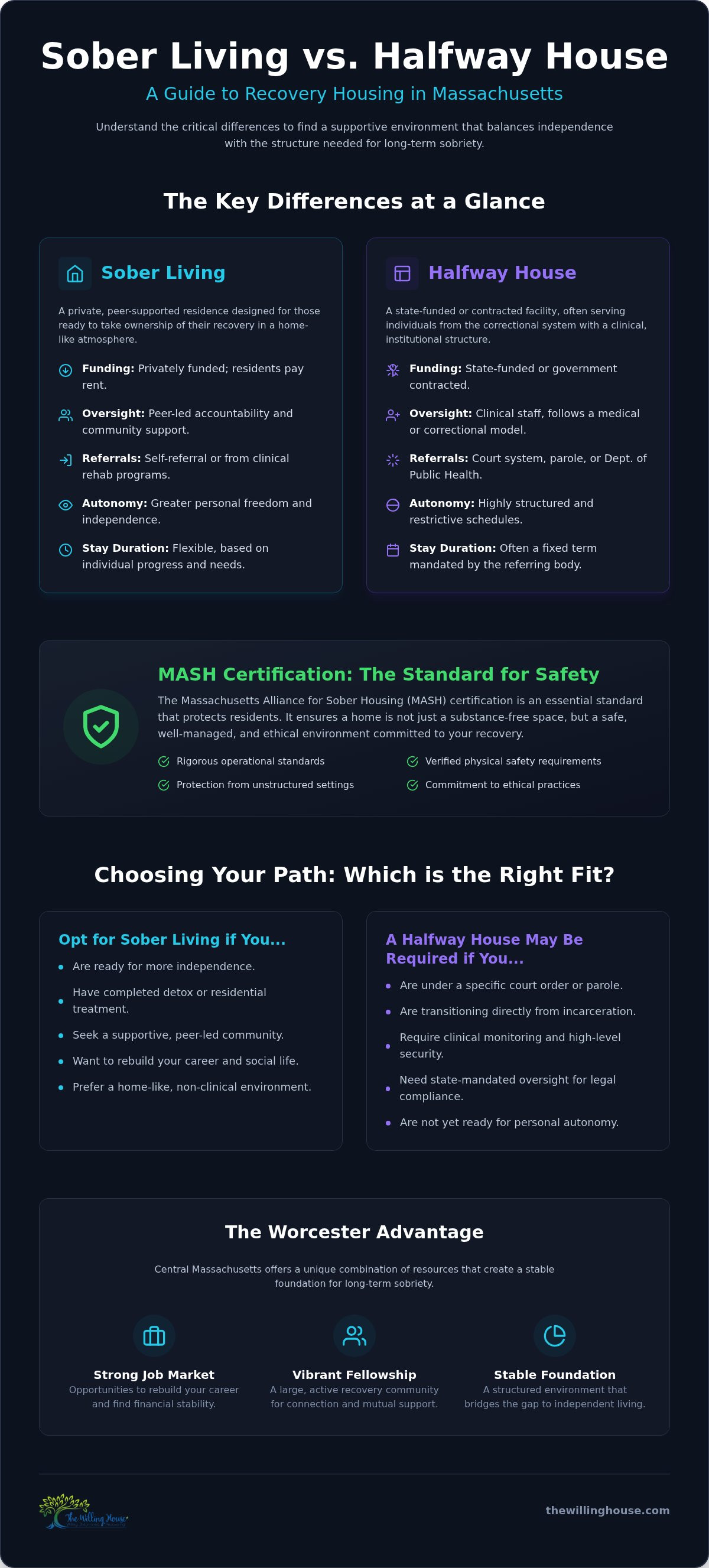
When you're searching for a safe place to land after treatment, the terminology can feel like a maze. Understanding the core distinctions of sober living vs halfway house massachusetts is the first step toward reclaiming your life. At its heart, a halfway house is typically a state-funded residential program that often serves individuals transitioning from the correctional system or those mandated by a court. These facilities are clinical in nature, meaning they have professional staff on-site and follow a strict, often rigid, medical or correctional model.
In contrast, sober living is a private, peer-supported residence designed for those who are ready to take more ownership of their recovery. Instead of clinical oversight, these homes rely on community accountability. It's a shift from being treated to being supported by a family of peers who are walking the same path. In the hierarchy of recovery housing, this represents a transition in the Level of Support, moving from external control toward internal discipline and self-governance.
The Role of Sober Living in the Continuum of Care
Sober living houses (SLHs) serve as a vital bridge between the protective bubble of inpatient rehab and the often chaotic reality of independent life. The first 90 days of sobriety are statistically some of the most vulnerable. During this window, having a drug-free environment isn't just a preference; it's a necessity for survival. A structured home provides the space to practice new coping skills without the immediate triggers of your old neighborhood.
While these homes offer more freedom than a hospital setting, don't mistake independent for unsupervised. In a MASH-certified home, structure is woven into the fabric of daily life. Residents are expected to work, attend meetings, and contribute to the household. This creates a rhythm of responsibility that mirrors real-world demands while providing a safety net of peers who won't let you slip through the cracks. It's about finding a balance where you have the freedom to grow but the accountability to stay safe.
When a Halfway House is the Traditional Choice
Sometimes, the choice is made for you by legal circumstances. Halfway houses are often the required destination for those under parole or specific court orders. Because they are state-run or contracted, they prioritize clinical monitoring and legal compliance over personal autonomy. While this provides a high level of security for those in early transition from incarceration, it often comes at the cost of personal freedom.
In these facilities, your schedule is rarely your own. There are often significant limitations on where you can work or how many hours you can spend outside the house. For someone who is ready to rebuild their career or reconnect with family on their own terms, the institutional feel of a halfway house can sometimes feel restrictive. Understanding these boundaries helps you decide if you're ready for the peer-led accountability found in sober living or if you still require the state-mandated oversight of a traditional halfway house.
Sober Living vs. Halfway House: The Key Differences in Massachusetts
Choosing between sober living vs halfway house massachusetts often comes down to the level of autonomy you are ready to handle. While both options provide a substance-free environment, their operations differ fundamentally. Halfway houses are typically institutional facilities where the state holds the contract. Referrals usually come through the Department of Public Health or the court system, making them a primary choice for those with legal mandates or those coming directly from the correctional system. They are designed to be transitional, but they often prioritize clinical monitoring over personal freedom.
Sober living communities offer a more home-like atmosphere that emphasizes personal growth and mutual aid. Here, residents usually self-refer or transition directly from a clinical rehabilitation program once they've completed detox or residential treatment. It's a community built on choice rather than compulsion. This shift in atmosphere, from a facility to a home, often provides the psychological safety needed for true healing to take root. You aren't just a patient in a bed; you're a member of a household.
Funding and Insurance in MA Recovery Housing
One of the most common questions families ask is why insurance rarely covers the cost of sober living. According to Massachusetts General Law Chapter 17, Section 18A, sober homes are classified as alcohol and drug free housing rather than clinical treatment facilities. Because these homes don't provide medical services, they don't fall under standard health insurance or MassHealth coverage. While this might seem like a barrier, it actually allows these homes to remain independent and focused on peer support rather than insurance paperwork.
Halfway houses utilize state grants and contracts to cover costs. This makes them accessible for those without financial resources, but it often limits your ability to choose your specific home or location. Independent homes like The Willing House operate on a service fee model. This fee covers the cost of safe housing and peer-led programming. It's often more accessible than families realize, especially when you consider the value of a stable, MASH-certified sober home compared to the high cost of a relapse in an unstructured environment.
Structure and Daily Life: Flexibility vs. Mandate
Daily life in a halfway house is frequently dictated by mandatory clinical sessions and group therapy held on-site. These programs are designed for those who still need a high degree of professional supervision. For many, this level of control is helpful in the very beginning, but it can make it difficult to maintain a full-time job or rebuild a career. The focus is on stabilization within the facility walls.
Sober living offers a different kind of structure that prepares you for life in the real world. In Worcester, residents are encouraged to find local employment, attend outside treatment programs, or go back to school. The accountability isn't found in clinical mandates but in the backbone of house meetings, breathalyzers, and curfews. You're expected to be a productive member of the community. This flexibility allows you to integrate back into society while still having a secure place to return to every night. It's about learning to live sober while life is actually happening.
Navigating Sober Living Rules and Regulations in MA
Finding a safe place to stay shouldn't feel like a gamble. When you compare sober living vs halfway house massachusetts, the regulatory landscape looks very different. Halfway houses are licensed residential programs with heavy state oversight, but sober living homes are traditionally independent. This independence created a gap where "predatory" houses could once operate without standards. To solve this, the Massachusetts Alliance for Sober Housing (MASH) was established to provide a voluntary but rigorous certification process that separates high-quality homes from those that prioritize profit over people.
For anyone looking at a Worcester sober house, MASH certification is the single most important credential to verify. It ensures the home meets National Alliance for Recovery Residences (NARR) standards for safety, health, and operational integrity. These MASH certified sober homes must adhere to specific physical requirements, such as providing at least 70 square feet for the first bed in a room and maintaining strict bathroom ratios. This prevents the overcrowding and "warehousing" that can lead to high-stress environments and, ultimately, relapse. Certification isn't just a badge; it's a promise that the home is a functionally equivalent family environment rather than an institutional facility.
Accountability Protocols: Drug Testing and Breathalyzers
Accountability is the glue that holds a recovery community together. In a structured environment, random drug screening is a fundamental necessity to maintain the house's integrity. It protects every resident by ensuring the environment remains truly substance-free. Daily breathalyzer protocols serve as a tool for safety, not punishment. They offer a moment of check-in and reassurance for everyone under the roof. MASH standards serve as the voluntary quality benchmark for MA sober homes, ensuring these protocols are handled with dignity and professional consistency.
Resident Rights and House Grievance Procedures
A certified home must provide a clear code of ethics for its house managers and a transparent process for resolving conflicts. This protects you from unfair or "knee-jerk" evictions, which are a major source of anxiety for those in early recovery. Every resident has the right to a safe, inclusive environment that respects their journey, regardless of gender. By choosing a home that follows these standards, you're ensuring that your transition is managed with the heart of a supportive peer and the discipline of a professional organization. It creates a stable foundation where you can focus entirely on your growth without worrying about the stability of your housing.
Choosing the Right Fit: When to Opt for Sober Living in Worcester
Deciding on your next step requires an honest look at your current stability. While a halfway house offers the rigid oversight of state-funded facilities, sober living invites you to practice recovery in a more natural setting. If you're ready to find a job or return to school while being held accountable by a community of peers, this is often the better path. It's about moving from a patient identity to a resident identity. When comparing sober living vs halfway house massachusetts, the choice often hinges on whether you need the state to manage your schedule or if you're ready to build a life of your own with a safety net in place.
The Worcester Recovery Community
Worcester is often considered the recovery capital of Central Massachusetts for a reason. Its geography allows for a high concentration of resources that are easily accessible via public transit or a short walk. From the 12-step meetings at local clubs to the specialized outpatient services, the support network is robust. This density of fellowship means you're never more than a few blocks away from someone who understands your struggle. The "Worcester Advantage" also includes a job market that is historically friendly to those in transition, with many local employers valuing the dedication of individuals in structured recovery programs.
Questions to Ask Potential Sober Houses
Evaluating the community culture is just as important as checking the amenities. A home-like environment encourages tranquility and mutual aid, whereas a dorm-like facility can feel cold and temporary. We always recommend visiting a home before committing. Walk through the common areas, meet the house manager, and see if the atmosphere feels like a family. Accountability shouldn't feel like a punishment; it should feel like a shared commitment to everyone's safety. To ensure you're making a wise choice, keep these questions in mind during your tour:
- Is this house MASH-certified? This is the most critical factor for ensuring safety and operational standards in Massachusetts.
- What is the policy regarding relapse and readmission? A clear, compassionate plan protects the integrity of the whole house.
- How are house chores and community responsibilities divided? Shared duties build the discipline and investment necessary for long-term success.
- Are there specific curfews or meeting requirements? Understanding the house rhythm helps you plan your work and family life.
If you're ready to see how a structured, peer-led community can support your journey, contact The Willing House to learn more about our MASH-certified Worcester homes and how we balance independence with safety.
The Willing House: A MASH-Certified Community Built on Accountability
The Willing House was founded on a simple but powerful belief: recovery is more sustainable when it happens within a community of peers. We don't just provide a place to sleep; we offer a structured environment in Worcester where men and women can practice the daily discipline of sobriety. Our mission is to bridge the gap between intensive treatment and the responsibilities of independent life. When families weigh the benefits of sober living vs halfway house massachusetts, they often choose our model because it prioritizes personal dignity while maintaining the firm boundaries necessary for safety. We believe that by creating a culture of mutual aid, we help our residents build a life they can finally be proud of.
A Safe Haven in Central Massachusetts
Our commitment to safety is rooted in our status as a MASH-certified organization. This certification isn't just a label; it's a promise that our homes meet rigorous state standards for physical safety and operational integrity. In a landscape where unstructured environments can feel unpredictable, we offer a sense of security through proven protocols. Our residents are surrounded by peers who understand the specific challenges of early recovery because they're living them alongside you. This shared experience creates an atmosphere of encouragement that a clinical facility simply cannot replicate. For a deeper look at how these standards protect our community, you can read our MASH Certified Sober House in Worcester, Massachusetts: A Complete Guide to Recovery Housing.
Taking the Next Step Toward Lasting Success
Structure at The Willing House is designed to empower, not restrict. We use random drug screening and daily breathalyzer protocols to ensure our environment remains a sanctuary for everyone. This accountability provides the peace of mind needed to focus on external goals, such as repairing family relationships or establishing a professional foundation. Many of our residents find that the stability of our homes allows them to excel in the local Worcester job market. We aren't here to manage your every move; we're here to provide the foundation that makes your next move possible.
Starting the intake process is a straightforward, supportive experience. Whether you're looking for our men's or women's homes, we focus on finding individuals who are truly ready to commit to a peer-supported lifestyle. We'll walk you through the house expectations and help you understand how our community fits into your larger recovery plan. Our goal is to ensure that every new resident feels welcomed and informed from day one. If you're ready to transition into a home that values your growth and your safety, Contact The Willing House today to learn more about our Worcester community.
Your Path to a Sustainable Life in Recovery
Choosing between sober living vs halfway house massachusetts is one of the most significant decisions you'll make in your early recovery journey. While halfway houses provide essential stabilization for those with state mandates, a MASH-certified sober home offers the freedom and peer-led accountability needed for long-term independence. You don't have to navigate this transition alone or settle for an environment that feels like an institution. By prioritizing certified standards and a supportive fellowship, you're investing in a future where sobriety is a way of life rather than a set of rules.
The right home should feel like a sanctuary. It should be a place where routine builds discipline and community fosters hope. Located in the heart of the Worcester recovery community, we provide a safe, structured environment for both men and women to thrive. If you're ready to move beyond clinical oversight and into a life built on mutual aid and personal dignity, we're here to help you take that next step. Join a supportive recovery community at The Willing House and discover the foundation you need for lasting success. You've worked hard for your sobriety; now it's time to build a life you're proud to live.
Frequently Asked Questions
Is a sober living home the same as a halfway house?
No, they serve different roles in the recovery journey. Sober living is a private, peer-led residence focused on community accountability, while a halfway house is a state-funded, clinical facility often mandated by the court. The distinction of sober living vs halfway house massachusetts is essential because it determines whether you live in a home-like environment or an institutional one. Halfway houses provide on-site medical staff, whereas sober homes rely on mutual aid.
Does insurance cover sober living in Massachusetts?
Generally, health insurance, MassHealth, and Medicare don't cover the residence fees for sober living because it's considered housing rather than clinical treatment. However, your insurance may still cover the costs of outside clinical services you receive while living there, such as outpatient therapy or medication management. Most residents use private funds or family support to cover the weekly service fees that keep the home and its peer programs operational.
What does MASH certified mean for a sober house?
MASH certification means the home has voluntarily met the rigorous safety and operational standards set by the Massachusetts Alliance for Sober Housing. These standards ensure the home provides a safe, healthy, and "functionally equivalent family" environment. It protects residents from overcrowding and ensures that house management follows a professional code of ethics. This certification is the gold standard for quality and safety for anyone seeking recovery housing in the Commonwealth.
How long can you stay in a sober living environment?
Stays in sober living are typically open-ended, allowing you to remain as long as you're following house rules and making progress in your recovery. Unlike halfway houses, which often have fixed three to six month mandates, sober living provides the flexibility to stay for a year or more. This long-term stability is vital for building a solid foundation and a supportive network of peers before you return to fully independent living.
Do I have to finish rehab before moving into a sober house?
While most residents transition into a sober house after completing a residential treatment or detox program, it isn't always a legal requirement. However, you must be able to demonstrate a commitment to sobriety and pass an initial drug screening. Most homes prefer that you've stabilized in a clinical setting first. This ensures you're ready for the peer-led accountability and the daily responsibilities that define a structured, substance-free living community.
Are there curfews in MASH certified sober homes?
Yes, curfews are a standard part of the structure in MASH-certified homes to ensure the safety and predictability of the environment. These curfews aren't meant to be restrictive; they help maintain a quiet, respectful household and ensure everyone is accounted for each night. As you progress in your recovery and demonstrate consistent accountability, some homes may offer more flexible hours to accommodate specific work schedules or important family commitments.
Can I work a full-time job while living in a sober house in Worcester?
Absolutely, and it's often encouraged as part of a structured living program. Worcester offers a robust job market with many employers who are supportive of individuals in recovery. Maintaining a full-time job helps you rebuild your professional foundation and practice time management while returning to a supportive community every evening. It's a key part of transitioning from a patient role back into a productive, self-sufficient member of the local community.
What happens if a resident relapses in a sober living house?
To protect the safety and sobriety of the entire community, a resident who relapses is typically required to leave the home immediately. This firm boundary is necessary to maintain a sanctuary for others who are working hard on their recovery. However, a nurturing community will often assist the individual in finding a higher level of care, such as detox, and may discuss a path for readmission once stability is regained.


