

The most dangerous day in your recovery journey isn't the day you started detox; it's the day you leave the protective walls of a clinical treatment center. You've worked incredibly hard to reach this milestone, but the thought of returning to an old environment can feel like walking a tightrope without a net. It's natural to feel a mix of pride and anxiety about maintaining your progress, especially when you're trying to figure out the difference between a halfway house vs sober living Massachusetts. You aren't alone in feeling overwhelmed by the choices ahead of you, and having the right information is the best way to quiet that uncertainty.
Understanding these nuances is the first step toward building a stable foundation for your new life. While both settings offer a reprieve from the triggers of home, they serve different roles in your transition to independence. This guide will clarify the critical differences between these paths so you can choose the environment that best supports your long-term success. We'll explore how MASH-certified housing provides a vital safety net through peer accountability and structured freedom. By the end, you'll have the clarity needed to step into the next phase of your journey with confidence and peace of mind.
Key Takeaways
- Understand why the first 90 days after treatment are the most critical for long-term success and how to protect yourself against early overconfidence.
- Compare the clinical, state-mandated structure of a halfway house vs sober living Massachusetts models that prioritize voluntary independence and peer support.
- Learn why MASH certification is the essential benchmark for safety and quality in recovery housing, ensuring your chosen home meets rigorous professional standards.
- Use our five-question recovery-readiness audit to objectively determine if your current home environment or a structured sober living community provides the best foundation for your growth.
- Discover how a structured living program helps you build a life of accountable independence while staying connected to a supportive fellowship of peers.
The Post-Rehab Crossroads: Why Your Next Step in Massachusetts Matters
Leaving the protective walls of a clinical treatment center is a moment of profound vulnerability. While you may feel a surge of optimism, often called the "Pink Cloud" phase, this early overconfidence can be deceptive. It's a period where the brain is still healing, and the sudden absence of round-the-clock support can lead to a quick return to old habits. Research indicates that the first 90 days of sobriety are the most critical window for preventing relapse. Understanding the differences between a halfway house vs sober living Massachusetts provides is essential for anyone transitioning out of a "rehab bubble" and back into the complexities of daily life.
In a residential facility, every hour is scheduled and every trigger is removed. The real world isn't as accommodating. Transitional housing serves as a strategic investment in your success, offering a controlled environment where you can test your new coping skills without the immediate pressure of total independence. It allows you to ground your recovery in reality while maintaining a safety net that catches you if you stumble.
The Reality of Returning Home Too Soon
Returning directly to your old neighborhood in Worcester or other Massachusetts cities often means facing the same people and places that fueled your addiction. Even with the best intentions, your previous "normal" was likely part of the problem. Family members may want to help, but they often lack the training to provide firm accountability or may inadvertently enable old behaviors. Physical triggers, like a specific street corner, a local bar, or a former social circle, can spark intense cravings that are difficult to manage alone. Without a buffer, the sudden weight of bills, relationship stress, and unstructured time can become overwhelming, making the familiar escape of substances look tempting once again.
Transitional Housing as a Buffer Zone
A Halfway house or a sober living community acts as a vital bridge between intensive care and full independence. These environments allow you to practice real-world skills while surrounded by a community that understands your struggle. Structure is a powerful tool against the chaos of addiction. By following a routine that includes employment, household chores, and shared responsibilities, you reinforce the discipline learned during inpatient treatment. This peer-supported environment provides several layers of protection:
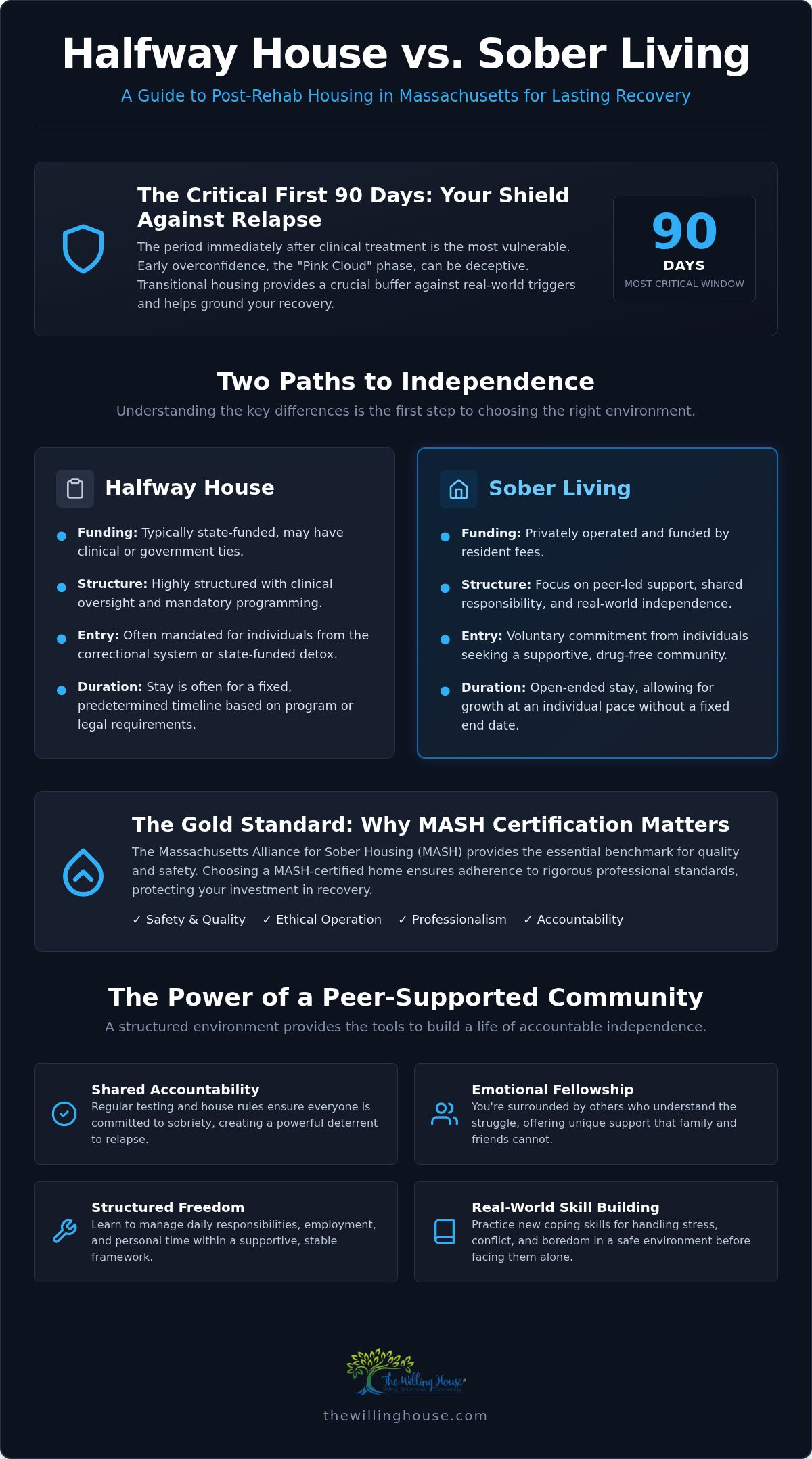
- Shared Accountability: Regular drug screens and breathalyzers ensure everyone in the home stays on track, providing a deterrent against impulsive choices.
- Emotional Fellowship: You aren't alone when the initial "high" of sobriety fades. Your housemates provide a unique form of support that only those in recovery can offer.
- Skill Building: These homes offer a safe space to learn how to handle stress, conflict, and boredom without turning to substances.
Choosing a structured path isn't a sign of weakness or a step backward. Instead, it's a courageous choice to give yourself the time and space needed to build a life you are proud to live. By prioritizing a gradual transition, you significantly increase your chances of maintaining the progress you've worked so hard to achieve.
Halfway House vs. Sober Living in Massachusetts: Defining the Differences
While the terms are often used interchangeably in casual conversation, the structural reality of a halfway house vs sober living Massachusetts offers is quite distinct. A halfway house is typically a state-funded residential facility that provides clinical oversight and structured programming. These environments are often mandated for individuals transitioning from the correctional system or state-funded detox programs. In contrast, sober living environments focus on a voluntary, peer-led model that prioritizes independent living within a safe, drug-free community. Understanding these definitions helps you decide whether you need the institutional support of a clinic or the domestic warmth of a peer-supported home.
The duration of stay also differs significantly between these two paths. Halfway houses often operate on a fixed timeline dictated by state funding or legal requirements. Sober living offers an open-ended growth model, allowing you to stay as long as you need to feel fully secure in your independence. Choosing MASH certified sober living after rehab ensures that your chosen environment follows the highest standards for health, safety, and peer support, regardless of how long your journey takes.
Mandated vs. Voluntary Residence
Residents in halfway houses are often there because of a court order or a state referral. While this provides a necessary safety net for those who need high-level supervision, the institutional nature can sometimes feel restrictive. Sober living is a voluntary choice made by individuals who are ready to take ownership of their recovery. When you choose your own environment, your personal buy-in increases. You aren't just following rules to satisfy a mandate; you're actively investing in your own future. This shift in motivation often leads to stronger long-term outcomes because the resident is a willing participant in the community.
Clinical Oversight vs. Peer Accountability
Halfway houses frequently employ clinical staff, such as case managers and counselors, creating an atmosphere that feels more like a medical facility than a home. Sober living houses prioritize a home-like feel while maintaining strict safety standards. This model relies on peer accountability rather than institutional oversight. According to Massachusetts law on certified sober homes, state agencies may only refer clients to homes that meet specific quality benchmarks. This ensures that even in a less clinical setting, residents are protected by professional standards. If you are looking for a place that balances this structure with the warmth of a genuine community, exploring MASH-certified options in Worcester can help you find the right foundation for your next chapter.
Critical Factors: Funding, Structure, and Accountability
Choosing between a halfway house vs sober living Massachusetts provides often comes down to the practicalities of funding and the level of structure you need to succeed. Halfway houses are generally state-funded facilities. Because they receive government support, they often have a more clinical feel and strict admission criteria. For those seeking financial assistance, the Recovery Housing Program (RHP) is a helpful state resource that supports individuals in certified environments. Sober living, on the other hand, is usually a private-pay model. While health insurance typically covers clinical addiction treatment like detox or intensive outpatient programs, it rarely covers the residential fees for sober living. This distinction is important because it changes the dynamic of the house from a patient-provider relationship to one of shared responsibility among peers.
The financial investment in a sober home often translates to a higher level of personal commitment. When you're paying for your stay, you're more likely to value the benefits of independent sober living, such as the increased privacy and the focus on long-term wellness. This model creates a sense of ownership that's hard to replicate in a mandated, state-run setting. It positions you as a resident and a community member rather than just a client in a system.
The Accountability Advantage
One of the biggest fears for someone fresh out of rehab is the lack of a safety net. In a MASH-certified home, accountability is built into the daily routine to ensure the environment remains a sanctuary. Regular breathalyzers and random drug screenings aren't meant to be punitive. Instead, they protect the safety of the entire community. If you're living at home, you're often relying on "trust," which can be fragile in early recovery. Professional oversight provides an objective barrier against the impulse to use, giving both the resident and their family members peace of mind. Key accountability measures often include:
- Daily breathalyzers: To ensure a safe, substance-free start to every morning.
- Random drug screenings: To provide a deterrent against impulsive choices.
- Weekly house meetings: To resolve conflicts and strengthen peer bonds.
Independence and Employment
A major difference in the halfway house vs sober living Massachusetts landscape is the focus on the workforce. Halfway houses often require residents to attend clinical groups during the day, which can limit your ability to find or keep a job. Independent sober living is designed to support your reintegration into the Massachusetts workforce. You're encouraged to work a full-time job, allowing you to regain financial stability while still coming home to a supportive, drug-free environment. Balancing house rules, like curfews, with the responsibilities of a career helps you practice "real life" in a controlled setting. This balance is what makes transitional housing a bridge rather than a destination.
Is Sober Living Right After Rehab? A Decision Framework
Deciding on your next step after clinical treatment is a deeply personal choice that requires honest self-reflection. While you've learned valuable tools in rehab, the transition back to daily life is where those tools are truly tested. Choosing between a halfway house vs sober living Massachusetts offers depends largely on your current level of stability and the safety of your destination. It's helpful to view this transition not as a delay of your independence, but as a strategic phase of growth. Before you commit to a path, take a moment to walk through a "Recovery-Readiness" audit to see where you stand.
Many individuals find that a sober house in Worcester, Massachusetts provides the necessary middle ground. It offers more freedom than a clinical facility but more protection than an unstructured home. One common hurdle is the financial commitment of private-pay housing. However, many families find it helpful to view these residential fees as "relapse insurance." The emotional and financial cost of a return to active use is far higher than the investment in a few months of structured support.
Auditing Your Home Environment
Your physical surroundings play a massive role in your early success. Be objective about where you're headed. Are there people in your home who still use substances or exhibit enabling behaviors that might compromise your boundaries? If your daily commute requires passing through high-risk areas or "old haunts" in your city, the mental strain can add up quickly. Most importantly, consider if there's a built-in support network at home that can provide the same 24/7 accountability found in a peer-led community. Without a sober household, the "loneliness" of early recovery can become a significant trigger.
Assessing Personal Recovery Strength
Recovery readiness is the ability to maintain boundaries under stress. While you might feel strong today, consider how you'll handle the sudden "freedom" of home life without a structured schedule. Ask yourself if you've already established a local 12-step or support network in your home city that you can lean on immediately. Transitioning too quickly can lead to a sense of overwhelm when the routine of rehab disappears. If you're unsure about your ability to manage these pressures alone, you can explore our structured living options to see how a peer community can bridge that gap.
Taking this audit seriously helps you step into your new life with eyes wide open. Whether you choose a state-mandated program or a voluntary sober home, the goal is to ensure you have the highest possible chance of long-term success.
Finding Stability at The Willing House in Worcester
Choosing between a halfway house vs sober living Massachusetts offers doesn't have to be a source of stress. While halfway houses provide a necessary service for many, those seeking a voluntary, peer-driven community often find their footing at The Willing House. As a MASH-certified leader in Central Massachusetts, we focus on helping men and women transition from the high structure of rehab to the nuanced reality of independent life. Our mission is simple but profound: we want to help you build a life that you are genuinely proud of, one where sobriety is the foundation for everything else you achieve.
At The Willing House, we provide gender-specific, safe environments in the heart of Worcester. We understand that recovery requires a delicate balance. You need the freedom to work a full-time job or attend outpatient treatment, but you also need the protection of strict accountability. Through regular breathalyzers, random drug screenings, and a culture of mutual aid, we ensure that your home remains a sanctuary. This structure isn't about control; it's about providing the security you need to focus on your growth without the fear of immediate relapse.
The MASH Certification Difference
Quality matters when your life is on the line. Meeting the standards set by the Massachusetts Alliance for Sober Housing (MASH) is the gold standard for recovery housing in the Commonwealth. For a house in Worcester to be MASH-certified, it must undergo rigorous audits that evaluate safety, ethical management, and resident rights. This certification protects you by ensuring the home is professionally managed, physically safe, and committed to a peer-supported model. When you choose a certified home, you are choosing an environment that has been vetted for its integrity and its ability to provide a stable foundation for your journey.
Taking the Next Step in Worcester
Worcester is an ideal hub for anyone in early recovery. The city offers abundant employment opportunities, a diverse range of 12-step meetings, and excellent public transportation, making it easier to manage the responsibilities of a new career. Transitioning directly from an inpatient program to The Willing House allows you to maintain the momentum you gained in treatment while slowly reintegrating into the workforce. Choosing this structured bridge today is the best way to secure your sobriety for tomorrow. It gives you the time to practice your coping skills in the real world while knowing that a supportive community is waiting for you at the end of every day.
Secure Your Success with a Structured Foundation
Choosing between a halfway house vs sober living Massachusetts offers is about more than just finding a bed; it's about selecting the right safety net for your unique needs. While halfway houses provide essential clinical oversight for those who require it, the voluntary model of a sober home fosters deeper personal buy-in and long-term independence. By prioritizing MASH-certified housing, you ensure that your environment meets the highest standards for safety and ethical management during those critical first months of sobriety. This transition allows you to practice the skills learned in rehab while staying grounded in a community that truly understands your path.
You've already done the hard work of starting your recovery. Now, give yourself the gift of time and support to make it last. Your future self will thank you for choosing a bridge that leads to lasting freedom rather than rushing back to an unstructured environment too soon. Our independent living model and supportive peer community in Worcester are designed to help you thrive as you step into this new chapter.
Frequently Asked Questions
Is sober living right after rehab for everyone?
Deciding on a halfway house vs sober living Massachusetts path depends on your need for clinical oversight versus independent peer support. While it isn't a mandatory requirement for every person, it's highly recommended for those who lack a safe, substance-free environment at home. If your old social circles in Worcester involve active users, this structured setting provides the peer-led fellowship you need to stay grounded while you build your new life.
How long do people typically stay in a sober living house in Massachusetts?
Most residents choose to stay in a sober living house for six to twelve months, though the duration is flexible based on personal growth. Unlike the mandated timelines often found in state-run programs, our model allows you to transition at your own pace. This open-ended approach ensures you don't feel rushed to leave before you've built a stable foundation. You stay until you feel fully confident in your independence.
What is the main difference between sober living and a halfway house in MA?
The primary distinction between a halfway house vs sober living Massachusetts residents consider is the level of clinical mandate and funding. Halfway houses are often state-funded and required by the courts; they feel more like institutional settings with clinical staff. Sober living is a voluntary, private-pay model that prioritizes a home-like feel. It focuses on peer accountability and independent living, giving you the freedom to work while maintaining a structured lifestyle.
Can I work a full-time job while staying at The Willing House?
Yes, residents are encouraged to maintain full-time employment as part of our structured living program. We believe that financial independence and a steady routine are essential components of a life you can be proud of. Our houses in Worcester are located near major employers and public transportation to make your daily commute manageable. We balance our house rules and curfews to support your professional responsibilities while keeping your recovery as the top priority.
Does insurance cover the cost of MASH-certified sober living?
Health insurance typically doesn't cover the residential fees associated with MASH-certified sober living. While insurance providers often pay for clinical services like detox or intensive outpatient programs, sober living is considered a residential recovery support service. Many families view these fees as a necessary investment in relapse insurance. By paying for a structured environment, you're securing a peer-supported bridge that significantly increases the likelihood of maintaining the progress you made during treatment.
What happens if someone relapses in a sober living environment?
Maintaining the safety and integrity of the community is our highest priority when a relapse occurs. If a resident returns to active use, they must leave the home to ensure the triggers don't compromise the recovery of their peers. We handle these situations with deep empathy but firm accountability. While we don't provide clinical treatment, we often help the individual find the appropriate level of care, such as a detox center.
How does MASH certification protect residents in Worcester?
MASH certification serves as the quality benchmark for recovery housing across the Commonwealth. In Worcester, this certification ensures that a home has passed rigorous inspections regarding fire safety, ethical management, and resident rights. It protects you from substandard living conditions and ensures the operators follow professional standards. When you choose a certified house, you're opting for a proven model of peer support that has been independently audited for its safety and effectiveness.
Can I attend outpatient treatment while living in a sober house?
Attending outpatient treatment is highly encouraged and often a core part of a resident's personalized recovery plan. Our independent living model is designed to give you the flexibility to attend your clinical appointments during the day while returning to a supportive peer community at night. This combination allows you to receive professional therapeutic support while practicing the real-world skills needed for independence. It's the perfect way to balance care with community life.


