

Imagine the moment you step out of the treatment center doors. The air feels different, and for the first time in weeks, you're the one holding the steering wheel. While that freedom is a victory, it often comes with a heavy side of anxiety. You might wonder how you'll handle a stressful phone call from your boss or what happens when you run into an old friend at the grocery store. Successfully avoiding relapse triggers after rehab isn't about having superhuman willpower; it's about engineering a life where those triggers lose their power over you.
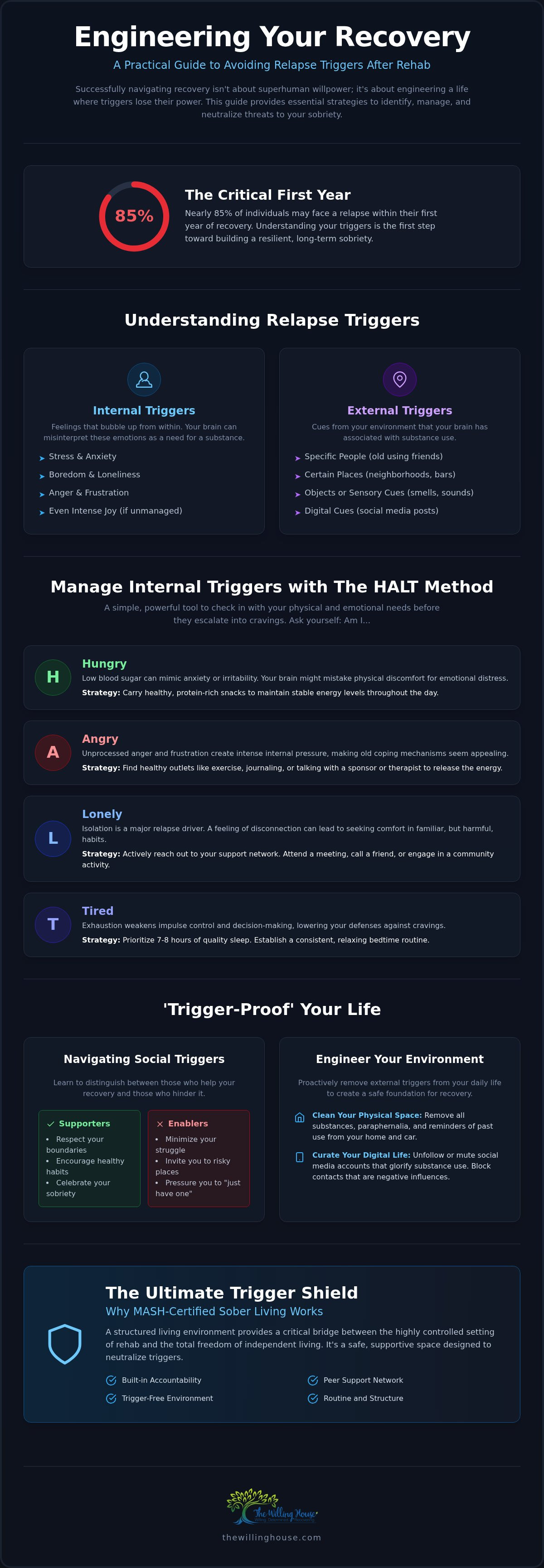
We understand that the transition from a clinical setting to home can feel like walking a tightrope without a net. Since nearly 85 percent of individuals face a relapse within their first year of recovery, it's completely normal to feel overwhelmed by a lack of structure or the pressure of old relationships. In this guide, you'll learn the essential strategies to identify, manage, and neutralize the people, places, and emotions that threaten your sobriety. We'll explore how to set firm boundaries with old friends and why finding a safe middle-ground, like a structured sober living environment, provides the stability you need. You'll walk away with a concrete plan to handle cravings and a clear path toward a stable, long-term recovery.
Key Takeaways
- Master the HALT method to identify how physical needs like hunger and exhaustion can lower your emotional defenses against cravings.
- Discover how "trigger-proofing" your physical environment and social media accounts is a vital step in avoiding relapse triggers after rehab.
- Learn to distinguish between supporters and enablers while using "scripting" to confidently navigate difficult social situations.
- Understand how the accountability of a MASH-certified structured living program creates a safe bridge between clinical care and independent living.
What Are Relapse Triggers and Why Do They Matter?
Recovery is a journey of rediscovery, but it's often shadowed by the fear of returning to old habits. Understanding What is relapse? helps demystify the process. A trigger is essentially a sensory or emotional cue that sparks your brain's "reward" memory, pulling you toward a substance before you've even had a chance to think. It's not a sign of weakness; it's a physiological response that your brain developed over time through repeated use. Your mind has learned to associate specific stimuli with a perceived sense of relief or pleasure.
In the protected environment of a treatment center, these cues are often filtered out. Once you leave that structured setting, your brain remains hypersensitive to the world around you. This makes avoiding relapse triggers after rehab a daily, active practice rather than a one-time decision. To manage this effectively, we view a Relapse Prevention Plan as a living document. It's a practical tool that evolves as you grow, helping you navigate the real world with confidence and a clear sense of direction.
Internal vs. External Triggers: The Core Differences
Triggers generally fall into two categories. Internal triggers are the feelings that bubble up from within, such as stress, anxiety, boredom, or even intense joy. Sometimes, the "celebratory" feeling of a good day can be just as dangerous as a bad one if it isn't managed with self-awareness. External triggers are the people, places, and things that surround you. This includes specific neighborhoods, the smell of a certain environment, or digital triggers like social media posts from old acquaintances who are still using.
When a trigger hits, you might experience what many call a "Crave Wave." These are intense but temporary surges of desire. If you can ride the wave for 15 to 20 minutes, the intensity usually subsides. Learning this timing is a vital part of avoiding relapse triggers after rehab, as it reminds you that the feeling is temporary, not a permanent state of being.
Why Your Brain 'Remembers' the Habit
Your brain is naturally wired for efficiency, and dopamine plays a central role in creating deep-seated association paths. When you used substances, your brain carved out "superhighways" for those habits. While rehab provides a necessary bubble, it can sometimes mask how loud these cues feel once you're back in your old environment. However, there is immense hope in biology. Neuroplasticity is the brain's ability to heal and rewire over time. By consistently choosing new, healthy responses to old triggers, you literally build new pathways toward peace and stability.
The HALT Method: Managing Internal Triggers Daily
One of the simplest yet most effective tools for avoiding relapse triggers after rehab is the HALT method. HALT stands for Hungry, Angry, Lonely, and Tired. These four states represent physical and emotional vulnerabilities that lower your "resistance ceiling." When your body or mind is depleted, your brain naturally looks for the quickest path to relief. For someone in early recovery, that old path often leads back to substance use. By checking in with yourself throughout the day, you can address these needs before they escalate into a craving.
Research into clinical relapse prevention strategies emphasizes that relapse is often a process that begins long before a person actually picks up a substance. Tracking your HALT states in a daily journal is a practical way to identify your specific patterns. You might notice that your stress levels peak on Tuesday afternoons or that you feel more vulnerable when you skip breakfast. Recognizing these trends allows you to build a routine that acts as a proactive defense rather than a reactive one.
Hungry and Tired: The Physical Foundations
Physical discomfort is often misinterpreted by the brain as emotional distress. Low blood sugar, for example, can mimic the symptoms of a panic attack or intense irritability. If you don't realize you're just hungry, you might feel an impulsive urge to self-medicate the "anxiety." Similarly, exhaustion is a massive relapse driver. Sleep deprivation weakens the part of your brain responsible for decision-making and impulse control. To keep your foundation strong, consider these steps:
- Carry healthy, protein-rich snacks to keep your blood sugar stable throughout the day.
- Establish a strict "lights out" routine to ensure you get at least seven to eight hours of rest.
- Avoid excessive caffeine, which can lead to energy crashes and increased jitteriness.
Angry and Lonely: The Emotional Vulnerabilities
Anger is a high-energy emotion that can make you feel justified in making poor decisions. When conflict happens at home or work, it's vital to use "Pause" techniques. Take a few minutes to breathe and ground yourself before responding to a stressful situation. Loneliness, however, is often more subtle and dangerous. There is a significant difference between being alone and feeling lonely. Loneliness is a sense of disconnection that can make recovery feel like a heavy, solitary burden.
Building a community of people who understand your journey is the best way to combat this. Staying in independent recovery housing provides a built-in support system that naturally mitigates isolation. When you share a living space with peers who are also focused on their sobriety, you're never truly alone in your struggles. If you find that your current home life feels isolating or unstructured, transitioning into a supportive living environment can provide the fellowship and routine you need to stay safe.
Environmental Engineering: How to 'Trigger-Proof' Your Life
You can't expect to stay healthy if you're constantly surrounded by the things that made you sick. Willpower is a finite resource, and if you're using all of it just to walk through your front door, you'll eventually run out. Environmental engineering is about making sobriety the path of least resistance. By deliberately "trigger-proofing" your surroundings, you take the pressure off your internal resolve. This proactive approach is the foundation of avoiding relapse triggers after rehab, turning your daily environment into a fortress of safety rather than a minefield of memories.
Start with the "Clean House" protocol. This goes beyond removing the substances themselves. It means purging every physical association, such as the glassware, the lighters, or even the specific chair where you used to sit. Next, perform a digital detox. Your smartphone is a direct portal to your old life. Block the numbers of people who don't support your recovery and unfollow social media accounts that glamorize substance use. If a specific route home takes you past a high-risk store or intersection, map out a new path. A slightly longer commute is a small price to pay for a quiet mind. Finally, ensure your bedroom is a sanctuary. Keep it clean, organized, and dedicated solely to rest and peace.
The Danger of the 'Old Neighborhood'
Returning to the exact same streets where you struggled often leads to an immediate spike in anxiety. The brain doesn't just remember the substance; it remembers the street signs, the smells, and the faces associated with it. These "people, places, and things" are often inextricably linked in your reward system, making it nearly impossible to separate the location from the habit. For many, the most effective way to break these ties is a fresh start in a new environment. Choosing a sober house in Worcester, Massachusetts allows you to build a new life in a city that doesn't hold your past against you.
Building New Rituals
Triggers often strike during specific time slots, such as the "happy hour" window between 5 PM and 7 PM or late at night. You must fill these gaps with positive rituals. Physical activity, like a brisk walk or a gym session, is particularly effective because it helps reset your brain's stress response and releases natural feel-good chemicals. You should also carry an "Emergency Kit." This isn't always a physical box, but a plan. It includes a list of three people you can call at any time and a grounding object, like a smooth stone or a photo, to help you stay in the present moment when a craving hits.
Navigating Social Triggers and Setting Boundaries
Social circles are often where the rubber meets the road in early recovery. While you've worked hard on your internal state, the people you once spent time with can present complex challenges. Successfully avoiding relapse triggers after rehab requires a clear distinction between "enablers" and "supporters." Supporters are those who celebrate your milestones and respect your new boundaries without question. Enablers, even if they mean well, might try to minimize your progress or encourage "just one" drink. Identifying these roles early is a survival skill.
A powerful tool in your arsenal is the "Scripting" technique. This involves practicing exactly what you'll say before you're in a high-pressure situation. If an old acquaintance offers you a substance, having a pre-rehearsed, firm response ready reduces the panic of the moment. If the urge starts to feel heavy, try "Playing the Tape." Visualize the entire night if you were to give in, from the initial high to the inevitable crash and the loss of everything you've built. Usually, seeing the end of the tape is enough to kill the craving.
Sometimes, setting a boundary isn't enough. It's perfectly okay, and often necessary, to "ghost" people who threaten your life. If someone consistently ignores your boundaries or tries to sabotage your sobriety, you don't owe them an explanation. Protecting your recovery is an act of self-preservation, not an act of unkindness. You're not being rude; you're staying alive.
How to Say No Without Explaining Everything
You aren't required to share your life story with every casual acquaintance. Short, firm responses like "I don't drink anymore" or "I'm focusing on my health right now" are perfectly sufficient. However, close family members might require deeper boundary setting. If certain relatives cause a "Relational Trigger," which is an emotional spike that makes you want to use, it's okay to limit your time with them. You have the right to curate who gets access to your energy during this vulnerable time.
Finding a New 'Tribe' in Worcester
Building a new social life doesn't mean being alone. It means finding people whose default is sobriety. Worcester has a vibrant recovery community, from local AA/NA meetings to sober-friendly events. One of the most effective ways to find this "tribe" is through MASH certified sober living. In these environments, peer accountability is built into the daily routine. You'll live with people who understand the weight of your journey because they're walking it too. If you're looking for a community that prioritizes your safety and growth, explore our structured living programs to find your place among peers who truly support your success.
Why MASH Certified Sober Living is the Ultimate Trigger Shield
While willpower and personal planning are essential, the environment you choose is often the most significant factor in avoiding relapse triggers after rehab. In Massachusetts, MASH (Massachusetts Alliance for Sober Housing) certification represents the gold standard for safety and accountability. This certification ensures that a home meets rigorous national standards, providing a structured setting that acts as a physical buffer against impulsive decisions. By choosing a certified home, you're placing yourself in a space specifically designed to minimize the chaos of early recovery.
The structure of a sober house, including curfews, daily chores, and mandatory meetings, isn't meant to restrict you. Instead, it creates a predictable rhythm that prevents the boredom and lack of direction that often lead to relapse. When your day has a clear beginning and end, your brain has less room to wander toward old habits. This environment allows you to practice the social scripting and boundary-setting techniques we discussed earlier within a supportive, peer-led community.
Random drug screenings and breathalyzers serve a unique purpose beyond simple monitoring. They provide a "positive out" when you face social pressure. If an old acquaintance pushes you to use, you have a concrete reason to say no: "I can't, my house does random testing." This shifts the pressure away from your personal resolve and onto the house rules, making it much easier to navigate difficult conversations without feeling like you're on the defensive.
Accountability as a Tool for Freedom
It's common to view drug screening as a form of oversight, but in a successful recovery community, it's viewed as a form of protection. Knowing that every person you live with is held to the same high standard provides immense peace of mind. It ensures that your home remains a sanctuary where everyone is moving toward the same goal. MASH standards ensure a home-like feel without sacrificing clinical safety. This balance allows you to focus on your transition back to work and family life while keeping your safety net firmly in place.
The Willing House: Your Worcester Recovery Community
At The Willing House, we pride ourselves on being a nurturing authority for men in transition. Our Worcester locations are designed to provide the perfect balance of independence and support, allowing you to rebuild your life at your own pace. We act as a bridge between intensive care and independent living, offering the discipline of a structured program with the heart of a peer-led fellowship. You don't have to walk this path alone. Build a life you are proud of at The Willing House and find the stability you need for long-term success.
Taking the Next Step Toward Lasting Recovery
The transition from treatment to daily life doesn't have to be a walk across a tightrope. By mastering the HALT method and engineering your physical and digital spaces, you turn your environment into a protector rather than a threat. Successfully avoiding relapse triggers after rehab is a skill that grows stronger with every boundary you set and every healthy peer you connect with. You deserve a foundation that values both your independence and your safety during this vulnerable time.
At The Willing House, we provide a safe and structured environment where accountability and fellowship go hand in hand. Our peer-supported recovery community offers the stability needed to bridge the gap between clinical care and a life of true freedom. You don't have to navigate these challenges alone. If you're ready to build a life you're proud of, Apply for MASH Certified Sober Living in Worcester today. You've already done the hardest work by starting your journey; now, let us help you protect it.
Frequently Asked Questions
What is the most common trigger for relapse after rehab?
Stress is widely considered the most common trigger. It's often the silent internal trigger that drives people back to old habits. In Worcester, this might manifest as financial pressure or family conflict. Managing stress is a core part of avoiding relapse triggers after rehab. By identifying stress early, you can use HALT or peer support to stay grounded before the pressure becomes unmanageable. This awareness helps you stay in control of your journey.
How long does it take for triggers to go away?
Triggers don't necessarily disappear completely, but their intensity fades over time as your brain heals. This process, known as neuroplasticity, allows new healthy habits to replace old associations. Within the first year, triggers are often at their peak. However, with consistent practice and a structured environment, those once-overwhelming urges eventually become manageable background noise rather than urgent commands to act. Time and patience are your greatest allies during this healing phase.
Can I ever go back to the same places I used to frequent?
It depends on the specific place and your stage of recovery, but early on, it's safest to avoid high-risk environments. If a specific Worcester neighborhood or establishment is tied to your old life, returning too soon can spark intense cravings. Your safety is more important than convenience. Over time, you may find you can return to certain areas, but only after building a solid foundation of sobriety and accountability with your peers.
What should I do if I am triggered and feel like I'm going to use?
Use your emergency kit immediately. This means calling a sponsor, a peer in your sober living community, or a trusted family member. Practice grounding techniques, like deep breathing, to ride out the crave wave. If you're in a high-risk situation, physically remove yourself from the area. Having a plan in place is essential for successfully avoiding relapse triggers after rehab when the pressure feels high. You don't have to face it alone.
How do I explain my new boundaries to my old friends?
You can be direct and firm without needing to provide a long explanation. A simple statement like, "I'm focusing on my health and won't be going to bars anymore," is often enough. Real friends will respect your decision and support your growth. If someone pushes back or tries to minimize your recovery, they're likely an enabler. It's okay to distance yourself from anyone who doesn't respect your need for a safe, substance-free life.
Is sober living better than going straight home after treatment?
For many, sober living provides a vital buffer that home life often lacks. Returning straight home can be overwhelming due to old associations and a lack of structure. In Worcester, a MASH-certified sober house offers a middle ground where you can work and attend treatment while living in a trigger-controlled environment. This community-focused approach significantly reduces the isolation that often leads to early relapse. It provides the stability you need to transition successfully.
What makes a sober house 'MASH Certified'?
MASH certification means the home meets the rigorous standards set by the Massachusetts Alliance for Sober Housing. This includes regular inspections, adherence to safety protocols, and a commitment to peer-led accountability. When a house is MASH certified, you know it's a legitimate, safe, and professional environment. It ensures that residents are supported by a community that values dignity and safety. This certification aligns with national standards for high-quality recovery residences.
How can family members help me avoid triggers?
Family members can help by respecting your boundaries and maintaining a substance-free home environment. They can learn the HALT method to help you spot when you're becoming vulnerable. Open communication is key; let them know which situations or topics of conversation feel risky for you. Their support is most effective when it's grounded in understanding rather than judgment. This creates a stable foundation for your long-term success and peace of mind.


