

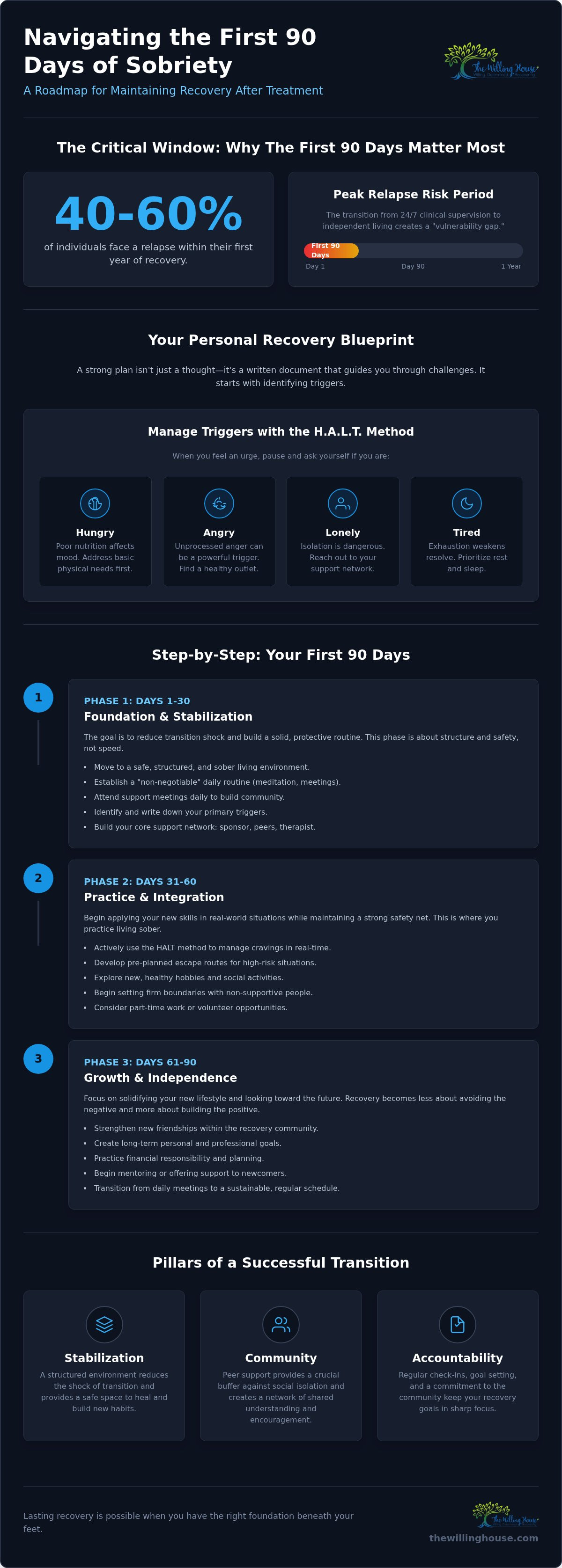
Did you know that 40% to 60% of individuals face a relapse within their first year of recovery? This data, while heavy, highlights that the highest risk period occurs during the first 90 days post-discharge. If you're feeling a mix of hope and intense anxiety about maintaining sobriety after treatment, you aren't alone. It's natural to fear the pull of old neighborhoods or the quiet sting of social isolation once the 24/7 supervision of a clinical setting ends.
We understand that the transition from a protected environment to independent living feels like a massive leap. You've worked hard to reach this point, and you deserve a plan that replaces confusion with clarity and fear with a sense of security. In this guide, we'll provide a practical roadmap for your first three months of independence. You'll learn how to build a supportive community, establish healthy routines, and find a safe home that offers both the freedom to work and the structure of peer accountability. Lasting recovery is possible when you have the right foundation beneath your feet.
Key Takeaways
- Understand why the first 90 days are the most critical period for maintaining sobriety after treatment and how to navigate this transition safely.
- Learn how to identify your specific emotional and social triggers to build a proactive relapse prevention plan that works in the real world.
- Discover how establishing a non-negotiable daily routine provides the structure needed to protect your peace of mind and personal dignity.
- Explore the vital role your physical living environment plays in long-term success and why choosing a certified, supportive home is a game changer.
- Gain a clear 90-day roadmap that balances your growing independence with the professional accountability of a peer-led community.
The Challenge of Maintaining Sobriety After Treatment
The moment you walk out of a clinical facility, you enter what experts call the "vulnerability gap." In a residential setting, every hour is accounted for and substances are physically out of reach. Transitioning back to a neighborhood where old triggers wait on every corner creates a shock to the system. Statistically, the first 30 to 90 days are the most critical for anyone focused on maintaining sobriety after treatment. During this window, the risk of relapse is at its peak because the safety net of 24/7 supervision has vanished, yet the skills needed for independent living are still new. This period requires more than just good intentions; it requires a "Recovery Bridge" that helps you move safely from clinical care to the complexities of daily life.
Why Willpower Isn’t Enough
Relying on sheer grit often fails because the neurobiology of early recovery is complex. Your brain needs time to stabilize after a long period of substance use. When you encounter old environmental cues, such as a specific street corner or a former social circle, your brain can trigger automatic responses before you even realize it. This is often compounded by "sobriety fatigue," a state of mental exhaustion that comes from the constant effort of making healthy choices. Sobriety is not just the absence of a substance; it's a profound shift in how you interact with the world. Without a supportive environment, the weight of these triggers can become overwhelming, making it clear that a change in surroundings is just as vital as a change in mindset.
The Importance of a Gradual Transition
Jumping straight from a clinical environment back into your old life is like trying to run a marathon after months of bed rest. The transition needs to be a gradual process rather than a sudden leap. A structured step-down approach allows for partial autonomy, giving you the chance to practice new habits while still having a safety net. This method helps mitigate the "all or nothing" thinking that often leads to setbacks. When you choose a path that prioritizes a steady pace, you give yourself the grace and time needed for lasting change.
- Stabilization: Moving to a structured environment reduces transition shock.
- Community: Peer support provides a buffer against social isolation.
- Accountability: Regular testing and check-ins keep goals in focus.
Maintaining sobriety after treatment isn't about rushing back to your old version of "normal." It's about intentionally engineering a new reality that values your well-being and protects your progress. By bridging the gap between intensive care and total independence, you create the stable foundation necessary for a life of dignity and purpose.
Building Your Post-Treatment Relapse Prevention Plan
A successful strategy for maintaining sobriety after treatment isn't something you keep in your head. It's a written, living document that guides your choices when cravings or stress cloud your judgment. This plan serves as your personal operating system, outlining exactly how you'll respond to life's challenges without returning to substance use. It starts with identifying your "Red Alert" triggers, which are the specific emotional, social, or physical cues that historically led to use. When you have these written down, they lose their power to surprise you.
Identifying and Managing Triggers
Triggers are rarely just about seeing a substance. They are often internal states or external environments that catch you off guard. Using Relapse prevention (RP) strategies helps you categorize these risks. A simple yet effective diagnostic tool is the HALT method. Whenever you feel an urge, ask yourself if you are Hungry, Angry, Lonely, or Tired. Addressing these basic needs often diffuses the immediate intensity of a craving. For external triggers, such as an unavoidable family gathering, you need a pre-planned escape route. This might include driving your own car, bringing a sober peer, or having a "check-in" call scheduled with your sponsor for the moment you arrive.
Beyond managing triggers, your plan must include a "Non-Negotiable" daily routine. This isn't a loose to-do list. It's a set of recovery tasks that happen regardless of how you feel. This might include morning meditation, attending a specific meeting, or calling an emergency contact from your pre-built list. Setting firm boundaries is also essential. You'll likely need to distance yourself from individuals who don't respect your new lifestyle. Protecting your peace is more important than avoiding an awkward conversation with someone from your past. Maintaining sobriety after treatment requires you to put your recovery first, even when it feels uncomfortable.
Establishing Accountability Measures
Internal motivation can fluctuate, especially during the first few months. That's why external accountability acts as a vital safety net. Regular drug screenings and daily breathalyzers provide a layer of protection that discourages impulsive decisions. These tools aren't about punishment. They are about maintaining the honesty and dignity you've worked so hard to regain. When you know a test is coming, it provides a logical "no" to the irrational voice of addiction.
Choosing an accountability partner is equally important. This person should be someone who understands the recovery journey and isn't afraid to ask the hard questions. They should be firm yet deeply supportive of your goals. If you're looking for a community that prioritizes this level of structure, exploring a Structured Living Program can provide the framework you need to stay on track.
The Geography of Sobriety: Why Your Environment Matters
Your physical environment often acts as the silent architect of your recovery. While willpower is a tool, the space where you sleep, eat, and relax dictates your daily exposure to risk. For many, the pull of a familiar neighborhood or a household where substances are present makes maintaining sobriety after treatment feel like an uphill battle. This is why choosing MASH certified sober living after rehab is often considered a gold standard. It shifts the focus from surviving your surroundings to thriving within a community specifically designed for your success.
Living with peers who share your goals creates a powerful psychological buffer. In this environment, you aren't the outlier; you're part of a collective effort. This shared experience combats the social isolation that often triggers a return to use. There's a distinct difference between independent living and isolated living. True independence includes the wisdom to seek a supportive foundation rather than trying to navigate the "vulnerability gap" alone. Isolation breeds the secrecy that addiction thrives on, while a communal environment fosters the transparency that keeps you safe.
Sober Living vs. Returning Home
Returning home immediately might seem like the quickest path to "normalcy," but it's often the riskiest choice you can make. You must honestly evaluate if your current home is safe. If others in the house use substances, or if the stress of old dynamics remains high, your progress is at risk. Gaining clarity on how halfway houses vs. sober living differ is also helpful. While halfway houses are often state-run and more clinical, sober living environments offer a warmer, more domestic feel while maintaining high standards of accountability. This domesticity helps you relearn how to live a quiet, dignified life without the sterile feeling of a hospital.
What to Look for in a Certified Sober House
In Massachusetts, the MASH (Massachusetts Alliance for Sober Housing) certification is the benchmark for safety and ethics. This certification ensures that the home meets rigorous standards for oversight and resident well-being. According to research on long-term recovery factors, stable housing and peer involvement are among the most significant predictors of sustained abstinence. When a house is certified, it means someone is looking out for your dignity and safety.
A quality home provides what we call a "nurturing authority." This means the environment is led by knowledgeable experts who understand the complexities of recovery but deliver that guidance with the heart of a supportive peer. For those seeking structured recovery housing in Central MA, these homes provide a steady foundation where you can practice your new skills. This balance of professional standards and home-like comfort is essential for maintaining sobriety after treatment. It allows you to build a life that feels both secure and full of potential, bridging the gap between clinical care and the life you've always wanted to lead.
Step-by-Step: The First 90 Days Post-Treatment
The first three months after leaving clinical care are often the most defining of your journey. While the "One Day at a Time" philosophy is your spiritual compass, a structured timeline provides the physical map. Success in maintaining sobriety after treatment requires a shift from being a passive recipient of care to an active architect of your new life. Research suggests that programs or structures lasting 90 days or more have nearly double the one-year recovery rate compared to shorter interventions. By breaking this window into manageable phases, you reduce the overwhelm that often leads to old coping mechanisms.
- Days 1-30 (Stabilization): Your primary job is to establish a routine. This includes identifying a "home group" for meetings and securing a local sponsor. During this month, minimize major life changes and focus solely on the basics of self-care, sleep, and accountability.
- Days 31-60 (Integration): As you feel more stable, you might begin re-engaging with work or education. The challenge here is ensuring that these responsibilities don't crowd out your recovery tasks. Meetings remain non-negotiable, even on busy days.
- Days 61-90 (Expansion): This is the time to strengthen your peer bonds. Start taking on service positions in your fellowship and look toward long-term goals, such as rebuilding financial stability or planning for future independent housing.
Re-entering the Workforce Safely
Returning to a job brings necessary income, but it also introduces professional stress. It's vital to communicate your needs clearly and maintain a hard boundary between your work hours and your recovery commitments. Managing workplace stress without turning to old habits requires a pre-planned toolkit of coping strategies. Living in a community that supports your right to work while requiring regular sobriety checks provides a unique safety net. You can pursue your career goals knowing that you have a secure, substance-free home to return to at the end of every shift.
Finding Fellowship in Worcester
Central Massachusetts has a vibrant recovery community with numerous meetings and sober events. To truly thrive, move beyond just attending; aim for active participation. This means arriving early to help set up, staying late to talk with others, and building a network that exists outside of meeting halls. A strong sober network in Worcester acts as a shield against the social isolation that often threatens early progress. Building these peer bonds ensures you have someone to call when the day feels heavy.
If you're ready to build this foundation in a supportive environment, learn more about our Peer Support and Fellowship programs.
Choosing the Right Path with The Willing House
The Willing House serves as the physical manifestation of the strategies we've explored in this guide. It's more than just a place to stay; it's a community designed to help you master the art of maintaining sobriety after treatment. We've built our homes on the principles of structure and peer support, ensuring that the 90-day roadmap we discussed isn't just a theory, but a lived reality. By choosing our sober house in Worcester, Massachusetts, you're stepping into an environment that respects your independence while providing the accountability needed to stay safe.
Our commitment to MASH standards ensures that every resident lives in a home that meets rigorous benchmarks for safety and ethical oversight. This certification isn't just a badge; it's a promise that your dignity and well-being are our highest priorities. We focus on a peer-led model where residents support one another, creating a shared culture of honesty and mutual aid. This environment replaces the isolation of the "vulnerability gap" with a sense of belonging and collective purpose.
A Nurturing Environment for Men and Women
We believe that healing happens best in spaces where you feel truly understood and protected. Our homes offer gender-specific support, allowing men and women to navigate their unique challenges in a safe, comfortable setting. This "domestic warmth" is a vital part of the recovery process. It helps transition the mind from the sterile atmosphere of clinical care to the healthy, productive rhythms of a life you can be proud of. Many of our residents find that the bonds they form here become the foundation of their long-term recovery network, proving that you don't have to carry the weight of your journey alone.
Take the Next Step Toward Lasting Sobriety
Applying for residency at The Willing House is a straightforward process designed to welcome you into our community with clarity and care. During the intake process, we focus on understanding your specific needs and goals, ensuring that our structured living environment is the right fit for your path forward. We act as a reliable protector of your progress, offering a stable bridge between intensive care and the independent life you're building.
Maintaining sobriety after treatment is a significant commitment, but it's one you're fully capable of achieving with the right foundation beneath your feet. You've already taken the hardest steps by completing your initial care and seeking a plan for your future. Now, let us provide the stability and peer support you need to make that progress permanent. Sobriety is a journey best taken together, and we're ready to walk beside you every step of the way.
Building Your Future on a Stable Foundation
You've worked hard to reach this point, and the path forward is about protecting that progress with clear intention. By understanding the vulnerability of the first 90 days and establishing a non-negotiable daily routine, you turn recovery from a daily struggle into a steady lifestyle. Success in maintaining sobriety after treatment isn't about doing it alone; it's about surrounding yourself with a community that values your dignity as much as your accountability.
We provide the bridge you need to move from intensive care to true independence. Our Worcester-based peer community is rooted in MASH Certified excellence, offering an accountability-first approach that keeps your recovery goals in clear focus. You don't have to navigate the transition shock in isolation when a supportive, domestic environment is ready to welcome you home. Join a community built for your success; explore The Willing House today.
Take comfort in knowing that a life of purpose and peace is within your reach. Your journey is just beginning, and we're here to help you make it last.
Frequently Asked Questions
What is the most common cause of relapse after treatment?
The most common causes of relapse are social isolation and a lack of structured daily routine. Without a clear plan for maintaining sobriety after treatment, individuals often return to old environments that trigger cravings. These high-risk situations, combined with the stress of navigating life alone, can lead to impulsive decisions. Building a strong community in Worcester provides the accountability needed to identify these risks early. It ensures you have support before a challenge becomes a crisis.
How long should I stay in a sober living house after rehab?
Most experts recommend staying in a sober house for at least 90 days. Many residents choose to stay for six months to a year to ensure their foundation is truly solid. This duration allows the brain time to stabilize and for new habits to become second nature. In a structured environment like ours, you have the time to build a life you're proud of while gradually increasing your independence. Your safety always comes first.
Can I work a full-time job while maintaining my sobriety plan?
Yes, working a full-time job is a vital part of many recovery plans. Our structured living program in Worcester is specifically designed to balance professional responsibilities with recovery tasks. Residents are encouraged to seek employment, as these activities build dignity and financial stability. The key is maintaining your recovery routine, such as attending meetings and participating in drug screenings, as your primary priority. This balance allows you to grow professionally while staying safe.
What is MASH certification and why does it matter in Massachusetts?
MASH stands for the Massachusetts Alliance for Sober Housing. This certification ensures that a sober living environment meets rigorous state standards for safety, cleanliness, and ethical management. Choosing a MASH-certified home in Worcester means you are entering a space that has been vetted for quality. It provides peace of mind for residents and their families. This oversight ensures the home acts as a legitimate bridge between clinical care and independent living while maintaining high professional standards.
How do I handle old friends who still use substances?
Handling relationships with friends who still use requires firm boundaries and, often, a period of distance. Your priority must be maintaining sobriety after treatment, which means avoiding environments where substances are present. It's okay to explain that you're focusing on your health. Surrounding yourself with a new peer community in Worcester helps replace old social circles. You'll find new friends who support your growth and understand the complexities of your journey.
Is it normal to feel "sobriety fatigue" after a few months?
Sobriety fatigue is a very normal experience during the first few months of recovery. It's the mental exhaustion that comes from the constant effort of making healthy choices and resisting old habits. This feeling doesn't mean you're failing; it simply means your brain is working hard to rewire itself. Leaning on peer support and maintaining a steady routine can help you navigate these low-energy periods. It's a sign that you're doing the hard work of lasting change.
What should I do if I feel a relapse is imminent?
If you feel a relapse is imminent, you should immediately reach out to your emergency contact list or a sober peer. Don't wait for the feeling to pass on its own. Using the HALT method can help you identify immediate physical or emotional needs that are clouding your judgment. In a structured community like ours in Worcester, you have access to people who can sit with you through the craving. Reaching out is a sign of strength.
How does peer support differ from clinical therapy?
Peer support focuses on shared lived experience and mutual aid, while clinical therapy involves professional medical treatment. At The Willing House, we provide peer support and fellowship. This offers a level of understanding that only someone who has walked the path can provide. While we don't offer clinical addiction treatment, our community acts as a foundation. It's a place where you can practice the skills learned in therapy within a safe, domestic environment.


